 ultimate-guide
Waste Hauling Operational Audit Checklist
Table of Contents
- Defining Audit Goals and Scope
- Assembling Your Audit Team and Responsibilities
- Waste Fleet Maintenance Best Practices Assessment
- Waste Hauling KPI Metrics and Performance Data
- Compliance, Regulatory Requirements, and Documentation Review
- Waste Management Operational Audit Template and Tools
- Post-Audit Action Planning and Vendor Management
- Frequently Asked Questions
Last Updated: September 25, 2026
Defining Audit Goals and Scope
An operational audit checklist for waste hauling evaluates fleet performance, identifies inefficiencies, and ensures regulatory compliance. The scope determines what gets measured, who participates, and what outcomes matter most.
Clarify your primary objectives: reducing breakdowns, improving route efficiency, ensuring compliance, or cutting costs. Each goal shapes the audit differently, breakdown-focused audits prioritize maintenance history; compliance-focused audits emphasize documentation and hazardous waste handling.
Define scope clearly: which vehicles, locations, and time periods will the audit cover. Many operators start with a pilot audit on 20-30% of their fleet, then expand once refined.
Document your audit scope in writing to prevent scope creep, align the team, and create a baseline for improvement.
Assembling Your Audit Team and Responsibilities
Your audit team's composition directly affects finding quality and implementation likelihood. The best operational audit checklists involve cross-functional teams with shop floor expertise, operations oversight, and management perspective.
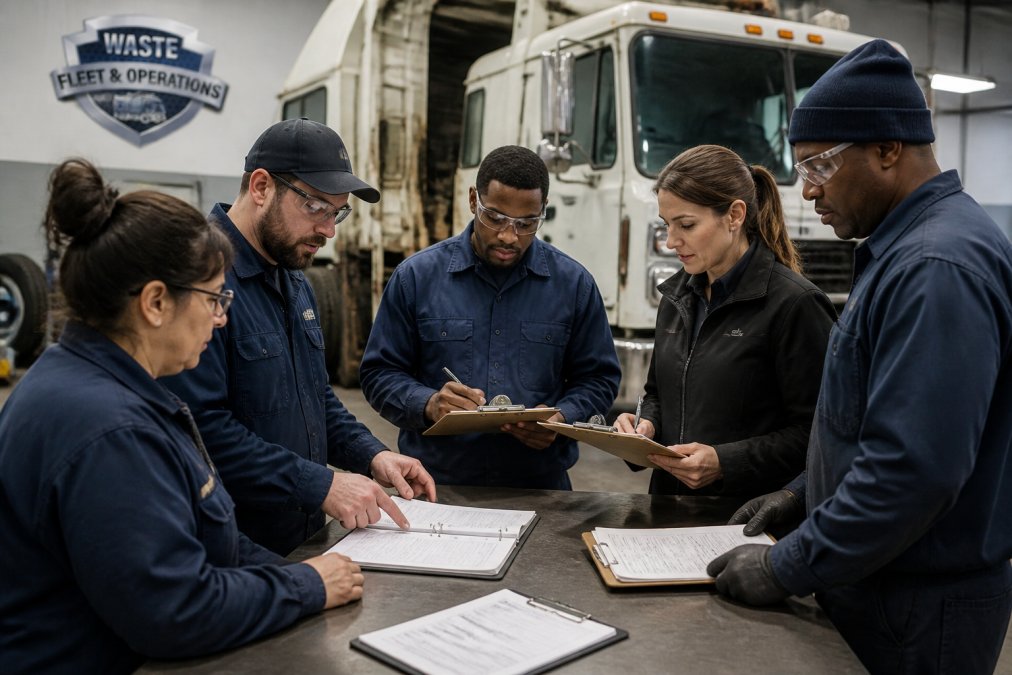
Assign clear roles: audit lead (checklist, timeline, report), maintenance technicians (vehicle condition, failure patterns), operations managers (route efficiency, maintenance impact), safety personnel (hazmat handling, compliance), and drivers (operational realities).
Set expectations upfront: the audit is diagnostic, not punitive. The goal is identifying root causes and building better processes, not assigning blame.
Waste Fleet Maintenance Best Practices Assessment
Your waste hauling operational audit checklist must evaluate whether current maintenance practices match industry standards and your fleet's actual needs.
Review your preventive maintenance schedule against manufacturer recommendations and industry benchmarks. Waste hauling stresses equipment harder than standard trucking: frequent stops, heavy loads, and dusty environments require different intervals than highway driving.
Assess your maintenance documentation. Can you quickly pull complete service history? Do records show what was actually done, or just dates and labor hours? Poor documentation wastes budget and masks recurring issues.
Evaluate your parts inventory strategy. Stock critical components based on failure rates and lead times; reactive ordering causes road calls and downtime.
Review technician training and certification. The gap between shop floor capability and equipment complexity often explains why breakdowns continue despite maintenance spending.
Waste Hauling KPI Metrics and Performance Data
Effective operational audit checklists track specific metrics: vehicle downtime, mean time between failures, maintenance cost per mile, fuel efficiency, and compliance violations.
Downtime measures fleet capacity unavailable due to maintenance. A 100-truck fleet averaging 15 days downtime per truck annually loses 4,100 operational days, directly impacting revenue and reliability.
Mean time between failures (MTBF) shows how long vehicles run before unplanned repairs. Higher MTBF indicates effective preventive maintenance.
Maintenance cost per mile isolates true operational costs. Calculate total annual maintenance spending divided by total miles driven.
Fuel efficiency trends signal mechanical problems before breakdowns. A sudden drop in MPG might indicate failing injectors, brake drag, or transmission issues.
Compliance violations during audits (improper labeling, inadequate storage, incomplete waste logs, chain of custody gaps) indicate where training and process improvements are needed. Track violations by category to identify systemic issues.
Compliance, Regulatory Requirements, and Documentation Review
Regulatory compliance is non-negotiable in waste hauling. Your waste hauling operational audit checklist must verify that your operation meets federal, state, and local requirements for hazardous waste handling, transportation, storage, and recordkeeping.
Review waste stream documentation. Can you trace every waste type, its classification, storage location, handling procedures, and disposal method? Gaps create liability and regulatory risk.
Verify labeling compliance by inspecting actual bins and storage areas, not just procedures. Documentation often shows compliance while field conditions reveal missing or incorrect labels.
Check storage procedures: incompatible waste streams separated, storage time within limits, containers in good condition. Storage violations are among the most commonly cited compliance issues.
Review recordkeeping: waste logs should document what was collected, from where, when, quantity, and destination. Chain of custody documentation must be accessible and accurate.
Assess staff training documentation. Verify training records are current, cover your specific waste streams, and refresher training occurs on schedule.
Book My Complimentary Discovery Call →
Waste Management Operational Audit Template and Tools
A structured operational audit template ensures consistency. Include sections for facility inspection, vehicle assessment, documentation review, compliance verification, and staff interviews.
The facility inspection section covers storage areas, containment systems, labeling, housekeeping, and emergency response equipment. Document conditions with photos.
The vehicle assessment section examines mechanical condition, maintenance records, hazmat placards, and safety equipment. Include brakes, tires, fluid leaks, lights, mirrors, and emergency equipment.
The documentation review section verifies waste logs, manifests, training records, inspection reports, and maintenance schedules. Cross-reference maintenance records against service intervals.
The compliance verification section confirms EPA, state, and local compliance, including generator status, waste classification, and handling procedures.
Digital Audit Tools vs. Manual Paper Logs
Many waste hauling operations still rely on paper checklists and manual spreadsheets, but digital audit tools offer significant advantages when implemented correctly. Understanding the trade-offs helps you choose the right approach for your operation.
Paper-based audits require minimal investment and work offline. However, they create delays in data consolidation, make pattern analysis difficult, and increase risk of lost records. Data entry errors multiply when transcribing to spreadsheets.
Digital audit tools enable real-time data capture, automatic photo timestamping, and immediate report generation. Data is centralized, searchable, and easier to analyze. However, they require device investment, staff training, and reliable connectivity.
A hybrid approach works well: use digital tools for primary audits and paper backup for areas with poor connectivity.
Selecting a tool: If your operation already uses fleet management software (Samsara, Verizon Connect, Geotab), check whether it includes audit or inspection modules. Integrating audits into existing software reduces training burden and keeps all operational data in one system. If you're starting fresh, consider whether you need a specialized audit tool or whether a simple mobile form builder (Google Forms, Typeform) with photo upload capability meets your needs. Specialized waste management audit software often includes pre-built compliance checklists for EPA and state regulations, which saves customization time but costs more.
Data integration matters: The most powerful digital tools connect audit findings to maintenance scheduling, compliance tracking, and KPI dashboards.
Post-Audit Action Planning and Vendor Management
The audit itself is not the goal. Converting audit findings into operational improvements and measurable financial gains is. Post-audit action planning determines whether your investment in the audit actually reduces breakdowns, improves compliance, or cuts costs.
Prioritization and Corrective Action Framework
Prioritize findings by severity and impact. Critical findings (safety hazards, immediate regulatory violations) require immediate action, within 48 hours for safety issues, within 5 business days for compliance violations. Major findings (efficiency gaps, compliance gaps, recurring maintenance issues) need correction within 30-60 days. Minor findings (process improvements, documentation cleanup, non-critical maintenance) can be addressed within 90 days.
Waste Reduction and Cost-Benefit Analysis
Many audits identify operational inefficiencies but don't quantify the financial impact. Connecting audit findings to cost savings helps justify corrective actions to leadership and builds momentum for change.
Vendor Management and Performance Auditing
If you outsource maintenance, parts supply, or specialized waste handling services, your audit should evaluate vendor performance, not just your internal operations.
Follow-Up Audit Schedule and Continuous Improvement
A one-time audit identifies current problems but doesn't sustain improvement. Establish a follow-up audit schedule: quarterly audits for the first year after the initial audit, then semi-annual audits once corrective actions are embedded. Follow-up audits track whether corrective actions stuck, whether new issues emerged, and whether KPI improvements are holding.
Frequently Asked Questions
How often should a waste hauling operational audit be completed?
Most operations benefit from comprehensive audits annually, with quarterly compliance spot-checks in between. The frequency depends on your fleet size, vehicle age, and regulatory environment. If you're experiencing frequent breakdowns or have recently acquired new equipment, more frequent audits help identify root causes faster. Post-audit follow-ups every 30-60 days ensure your team is implementing findings and maintaining progress.
What are the key performance indicators for waste fleet management?
Critical KPIs include breakdown frequency (target: under 2% of fleet daily), mean time between failures (MTBF), fuel efficiency per ton-mile, maintenance cost per vehicle annually, on-time route completion rates, and safety incident frequency. Track preventive maintenance completion rates and parts inventory turnover. These metrics reveal whether your waste fleet maintenance best practices are working and where to focus audit improvements.
What regulatory requirements must a waste hauling audit address?
Your audit must verify compliance with DOT vehicle maintenance standards (49 CFR Part 396), OSHA recordkeeping for vehicle incidents, EPA hazardous waste labeling and storage rules if applicable, state-specific commercial vehicle inspection requirements, and local permitting for waste collection routes. Document chain of custody procedures, driver qualifications, and hazmat training certifications. Regulatory fines for non-compliance can exceed $10,000 per violation, making audit verification essential.
How can digital audit tools improve over manual waste logs?
Digital tools provide real-time data capture, automated compliance alerts, and centralized recordkeeping that manual logs cannot match. They reduce transcription errors, enable faster trend analysis, and create audit trails for regulatory inspections. However, digital systems require proper training and integration with your existing fleet management software. A hybrid approach, using templates for initial data collection and digital tools for storage and analysis, often works best for smaller operations transitioning to structured audits.
What should be included in a post-audit action plan?
Prioritize findings by risk level and cost impact. Assign ownership for each corrective action with clear deadlines. Include a cost-benefit analysis for waste streams, focus on high-impact issues first (breakdowns costing $500+ per incident). Schedule follow-up inspections at 30, 60, and 90 days to verify implementation. Document progress against baseline metrics and communicate wins to your team to maintain engagement and accountability.
How do I measure success after completing a waste hauling operational audit?
Compare pre- and post-audit metrics: track breakdown reduction, maintenance cost savings, fuel efficiency gains, and on-time performance improvement. Monitor compliance inspection results and safety incident rates. If results fall short, conduct a root cause analysis, often the issue is incomplete technician training or inconsistent follow-up on procedures rather than a flawed audit.
Does this audit approach work for smaller waste hauling operations with 15-20 trucks?
Yes. Smaller fleets actually benefit more from structured audits because each vehicle's downtime has a proportionally larger impact on revenue. Start with a focused audit of your highest-mileage or oldest vehicles. Use a simplified template that covers essential areas: preventive maintenance compliance, driver safety practices, fuel consumption trends, and basic regulatory documentation. Scale up as you refine your process and build audit discipline within your team.