 ultimate-guide
Managing Aging Waste Collection Vehicle Fleets
Table of Contents
- Why Aging Waste Collection Vehicle Fleets Demand a Different Strategy
- Building a Waste Fleet Preventive Maintenance Schedule That Works
- Waste Collection Vehicle Replacement Criteria: When to Repair vs. Replace
- Telematics for Heavy-Duty Waste Trucks: Real-Time Monitoring and Driver Behavior
- Reducing Maintenance Costs for Aging Fleets Through Predictive Analytics
- Route Optimization and Fuel Efficiency for Older Collection Vehicles
- Technician Training and Regulatory Compliance for Aging Fleet Safety
- Conclusion: A Phased Approach to Managing Aging Waste Fleets
- Frequently Asked Questions
Last Updated: October 4, 2026
Why Aging Waste Collection Vehicle Fleets Demand a Different Strategy
Managing aging waste collection vehicle fleets is a different discipline than running newer trucks. At Waste Fleet & Operations, the pattern is consistent: an older truck doesn't fail gradually, it fails suddenly, usually on a route with a full load and no easy way to offload.
The core problem is compounding wear. The Federal Motor Carrier Safety Administration's vehicle maintenance guidance is blunt about this: out-of-service violations cluster around brake and lighting systems, and those are exactly the systems that degrade fastest on high-cycle collection trucks.
Treat your aging fleet as a portfolio of assets with different remaining lives. Some trucks get aggressive preventive maintenance because they'll run another five years; others get minimum safe spend because replacement is funded.
Building a Waste Fleet Preventive Maintenance Schedule That Works
A waste fleet preventive maintenance schedule works when intervals are set by duty cycle, not calendar. A residential rear-loader running 500 stops a day wears differently than a commercial front-loader doing 40 pulls; treating them the same over-services one and under-services the other.
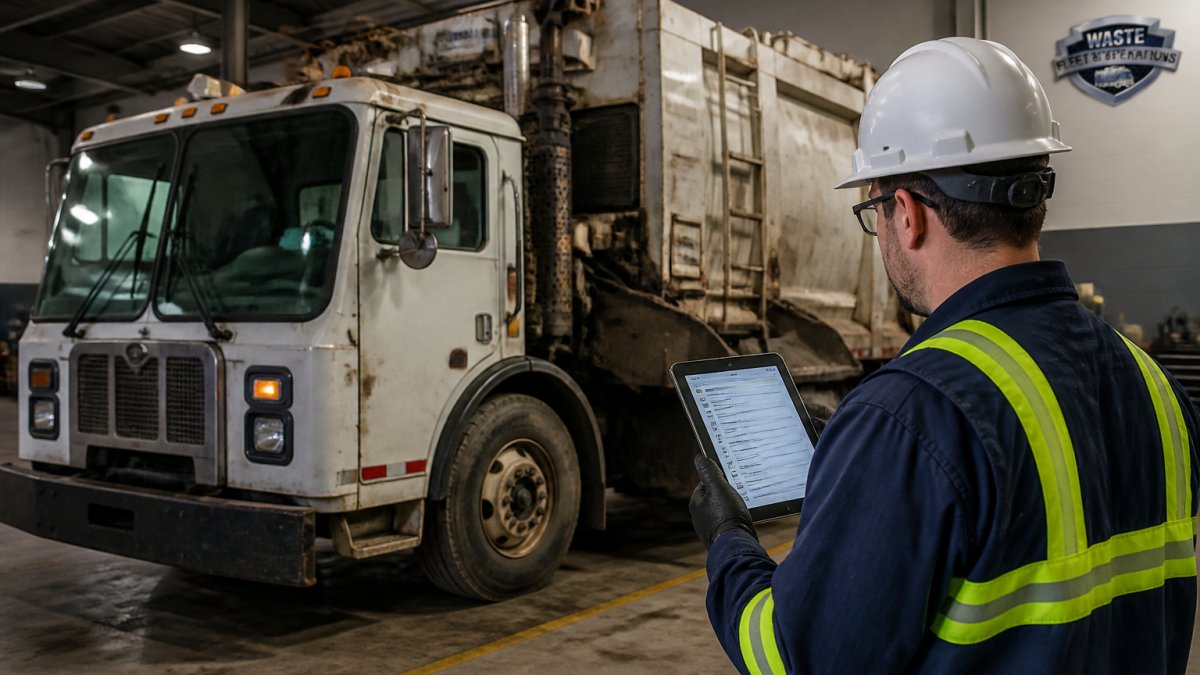
Setting Service Intervals by Vehicle Type and Route Density
Route density is the variable most schedules ignore. A truck on a dense residential route cycles its brakes, hydraulics, and packer hundreds of times more per shift than one on a spread-out commercial route.
Build intervals around three inputs:
- Stop count per shift, packer and brake wear scale with cycles, not miles
- Route density, tight routes mean more low-speed thermal load on brakes and transmissions
- Load profile, heavier average loads shorten suspension and tire life
Start with manufacturer baseline intervals, shorten them by a defined percentage for high-cycle routes, then review failure data quarterly and adjust.
Digital Inspections and Maintenance Logs That Catch Problems Early
Paper inspection sheets get filled out wrong, lost, or back-dated. Digital inspections with photo capture and forced fields change behavior, because a driver can't skip the brake stroke measurement without the form flagging it.
The bigger win is the maintenance log. When every repair, part number, and complaint is logged digitally, you can query patterns. Three hydraulic hose failures on one truck in six months isn't bad luck, it's a root cause you can chase.
Waste Collection Vehicle Replacement Criteria: When to Repair vs. Replace
Waste collection vehicle replacement criteria should be financial, not emotional. The truck your senior driver loves may cost the most per mile. Use a scoring approach that weighs total cost of ownership against remaining useful life.
Total Cost of Ownership and Capital Expenditure Planning
Total cost of ownership includes more than purchase price: maintenance and repair spend, fuel, downtime cost, insurance, and the resale value you give up by holding the asset longer.
| Signal | Repair | Replace |
|---|---|---|
| Annual maintenance as % of replacement cost | Below threshold | Rising for 3+ years |
| Unplanned downtime per month | Stable | Increasing |
| Parts availability | Standard stock | Long lead times |
| Route reliability | Meets targets | Chronic road calls |
| Residual value | Holding | Falling fast |
The threshold varies, but the principle holds: when annual maintenance spend climbs steadily and downtime hits route reliability, you're past the crossover point. Fund replacements on a rolling schedule, because capital expenditure planning done in a crisis always costs more.
Telematics for Heavy-Duty Waste Trucks: Real-Time Monitoring and Driver Behavior
Telematics for heavy-duty waste trucks turns guesswork into data. Real-time monitoring shows what the truck is doing now; driver behavior data shows why components fail early.
Modern telematics units pull fault codes, engine hours, fuel burn, brake events, and location.
Driver behavior matters just as much. Hard braking, excessive idle, and aggressive acceleration shorten the life of already-worn components.
Reducing Maintenance Costs for Aging Fleets Through Predictive Analytics
Reducing maintenance costs for aging fleets comes down to one shift: move from reactive to predictive. That shift only happens when the financial case survives a budget meeting, so this section builds the actual model.
The Real Cost of Run-to-Failure on a Collection Truck
A reactive posture looks cheaper because you only spend when something breaks, but that accounting hides the true cost of a failure event. When a hydraulic pump or packer cylinder fails on route, the invoice includes far more than the part:
- The replacement component and any collateral damage it caused
- Shop labor at emergency rates, often after hours
- Towing or a field service call to get the truck off the route
In hauling operations, the fully loaded cost of an on-route failure typically runs several times the cost of the same repair on a scheduled shop visit. The multiplier isn't the part, it's the failure event itself.
Building the Predictive vs. Reactive ROI Model
The comparison that wins budget approval isn't 'predictive is better,' it's a side-by-side of two cost streams over the same period.
Reactive stream: count your unplanned road calls per truck per year, multiply by the fully loaded cost per event, then add the secondary wear from shifting loads onto healthy trucks.
Predictive stream: add the cost of the monitoring program (oil analysis kits, vibration sensors, telematics fault-code review labor) plus the scheduled repairs those signals trigger.
The difference between the streams is your ROI.
What Predictive Actually Requires on a Waste Truck
Predictive analytics on a collection fleet doesn't require exotic technology, just clean data and the discipline to act on it:
- Oil analysis on engine, hydraulic, and transmission fluids, sampled on a fixed interval, tracked as a trend rather than a one-time pass/fail
- Vibration monitoring on rotating components like hydraulic pumps and cooling fans, where a rising signature precedes seizure
- Fault-code trending from the telematics unit, watching for intermittent codes that repeat before they become hard failures
None of these are new. What separates haulers who get ROI is ownership: assign one person to review trends weekly and convert signals into work orders. Data nobody reads is just a subscription.
A Phased Rollout That Fits a Real Budget
Most haulers can't instrument the whole fleet at once, and don't need to. A workable sequence:
Book My Complimentary Discovery Call →
- Start with oil analysis on the oldest third of the fleet, where failure risk is highest and the sample cost is lowest.
- Add fault-code review using telematics you likely already have, before buying new hardware.
- Layer in vibration monitoring on the component class that has caused your most expensive failures.
- Expand as the avoided-event savings fund the next phase.
The point isn't to buy a platform, it's to convert failure events into scheduled repairs and prove the savings with numbers you can defend.
Route Optimization and Fuel Efficiency for Older Collection Vehicles
Route optimization and fuel efficiency matter more on older trucks because they have less margin.
Start with route density. Consolidating stops and cutting deadhead miles reduces fuel consumption and the stop-start cycling that wears brakes and transmissions.
For fuel efficiency specifically, the basics still matter most on aging equipment:
- Keep tires properly inflated and matched
- Fix exhaust and intake leaks promptly
- Address aerodynamic drag from damaged body panels
Alternative fuels can lower per-mile cost, but converting an aging truck rarely pays back before it retires. Electrification is worth modeling for new procurement, not retrofitting end-of-life assets.
Technician Training and Regulatory Compliance for Aging Fleet Safety
Technician training and regulatory compliance are where aging fleets fail most often, and they're connected. Older trucks demand more skilled diagnosis, and a shop that can't diagnose properly produces unsafe repairs.
The Labor Shortage Is a Training Problem, Not a Hiring Problem
Experienced diesel technicians are hard to find and harder to keep. The haulers who win don't outbid the market for finished technicians; they build their own through structured, hands-on training on their specific equipment.
Classroom training doesn't stick; training on your trucks, with your failure patterns, does. A workable model:
- Pair new technicians with a senior tech for a defined period, with a checklist of competencies signed off as they are demonstrated
- Rotate trainees through each vehicle class so they understand how a rear-loader, front-loader, and roll-off fail differently
- Build a failure library from your own repair history, so diagnosis is taught against real cases rather than textbook ones
Training for Sensor-Heavy and Electrified Vehicles
This is where most aging-fleet programs fall behind. A truck built in the last several years carries far more electronics than the units it replaces: CAN bus networks, body controllers, hybrid systems, and diagnostic software requiring a laptop and training to interpret. A technician who can rebuild a hydraulic cylinder may not diagnose a fault in a multiplexed body control module.
The gap matters more on an aging fleet because you run both generations side by side. Your shop needs technicians who can service a mechanical packer and a sensor-driven one in the same shift. Plan for it explicitly:
- Budget for manufacturer and aftermarket diagnostic training as a recurring line item, not a one-time event
- Give technicians access to the diagnostic software and hardware for every vehicle class you run
- Treat high-voltage safety training as mandatory before anyone touches an electrified or hybrid unit
Regulatory Compliance and Safety Audits on Older Equipment
On the compliance side, aging trucks are more likely to fail inspections on brakes, lighting, and structural integrity. The Federal Motor Carrier Safety Administration's vehicle maintenance guidance is blunt that out-of-service violations cluster around brake and lighting systems, and those are exactly the systems that degrade fastest on high-cycle collection trucks. The Occupational Safety and Health Administration's guidance on workplace safety programs reinforces that documented, systematic safety programs reduce incidents, and the same discipline applies to fleet safety.
What aging fleets specifically struggle with:
- Emissions compliance as engines accumulate hours and aftertreatment systems wear, requiring more frequent inspection and repair to stay within standards
- Brake and lighting defects that appear between inspections on high-cycle routes
- Structural fatigue on bodies, arms, and packer components that pass a visual check but are past their design life
The fix is a documented, closed-loop inspection program: every defect logged and tracked to closure, and every failed inspection treated as a signal about the maintenance program rather than a one-off. Keep records current and retrievable, because a program you can't demonstrate is one you can't defend.
Closing the Communication Gap
The communication gap between the shop floor and management is where a lot of this breaks down. Technicians see problems first; if that information doesn't reach budget-holders, nothing changes. Give technicians a direct, documented channel to flag recurring failures and safety concerns, and review it on a fixed cadence. The cost of a missed signal is a road call, a failed inspection, or worse.
Conclusion: A Phased Approach to Managing Aging Waste Fleets
Managing aging waste collection vehicle fleets isn't a single project.
Most haulers can't do all of that at once, and they don't need to. The Environmental Protection Agency's resources on fleet and diesel emissions and similar guidance point in the same direction as the financial case: systematic maintenance and informed replacement reduce both cost and risk.
That's the work Waste Fleet & Operations does. We build preventive maintenance programs around your operation, not a template.
If your breakdowns are climbing and your maintenance spend is drifting, start with a conversation. Book My Complimentary Discovery Call and we'll look at your fleet with you.
Frequently Asked Questions
What is the average lifespan of a waste collection vehicle?
Most waste collection vehicles last 7 to 10 years or roughly 150,000 to 250,000 miles, depending on route density, vehicle type, and maintenance quality. Front-loaders and side-loaders on tight residential routes typically wear faster than roll-off trucks. Fleet managers should track service intervals, repair frequency, and total cost of ownership to decide when an aging unit no longer justifies continued investment. A structured waste fleet preventive maintenance schedule can extend useful life by 2 to 3 years.
How does preventive maintenance reduce costs for aging fleets?
Preventive maintenance catches small issues before they become major breakdowns. On aging waste fleets, that means fewer road calls, less unplanned downtime, and lower repair bills. A consistent schedule of inspections, fluid changes, and component replacements keeps vehicles in service longer and avoids the premium cost of emergency repairs. Fleet managers who track maintenance logs and service intervals can see significant reductions in daily breakdowns.
When is it more cost-effective to replace a waste truck than repair it?
Replace when annual repair costs exceed the vehicle's remaining value, or when downtime starts affecting route completion. A common rule is to replace a waste collection vehicle when it reaches 8 to 10 years old or when total cost of ownership climbs above the cost of a new unit's annual payment. Use waste collection vehicle replacement criteria that factor in mileage, repair frequency, parts availability, and safety compliance. Telematics data on vehicle health monitoring can make this decision clearer.
What role does telematics play in managing older fleet assets?
Telematics for heavy-duty waste trucks provides real-time monitoring of engine health, fuel efficiency, and driver behavior. On aging assets, that data helps fleet managers spot failing components before they cause breakdowns, schedule repairs proactively, and measure route density against fuel consumption. Telematics also supports predictive analytics, which compares current performance to baseline data and flags anomalies. This turns reactive maintenance into planned service intervals and reduces unplanned downtime.
How can fleet managers improve uptime for high-mileage collection vehicles?
Improve uptime by combining digital inspections, real-time monitoring, and a strict preventive maintenance schedule. High-mileage waste trucks need more frequent service intervals for brakes, hydraulics, and suspension components. Use maintenance logs to identify repeat failures and address root causes. Keep critical spare parts on hand for older models where parts availability is limited. Training technicians on root cause analysis and repair scheduling also reduces turnaround time and keeps vehicles on route.
What are the OSHA safety requirements for maintaining older heavy-duty vehicles?
OSHA requires that all vehicles be maintained in safe operating condition, including brakes, lights, tires, and steering. For older heavy-duty waste trucks, that means regular safety inspections and documented repair records. OSHA also requires that employees who operate or service vehicles receive proper training on hazards like hydraulic systems, compressed natural gas, and fall protection during maintenance. Fleet managers should keep maintenance logs current and ensure safety protocols cover aging equipment.