 blog
blog
Waste Truck Maintenance Cost Reduction Tips
Table of Contents
- Why Waste Truck Maintenance Costs Spiral Out of Control
- Diesel Engine Maintenance Costs: The Biggest Line Item in Your Budget
- Build a Preventive Maintenance Checklist for Refuse Trucks
- Reducing Heavy-Duty Truck Downtime Through Scheduled Maintenance
- Driver Training and Behavior: Your First Line of Defense
- Telematics and Predictive Analytics: Stop Guessing, Start Preventing
- In-House Repair vs. Outsourced Maintenance: The Total Cost of Ownership Calculation
- Inventory Management and Parts Procurement Strategy
- Frequently Asked Questions
Last Updated: September 28, 2026
Why Waste Truck Maintenance Costs Spiral Out of Control
Most fleet managers don't realize their maintenance costs are spiraling until the damage is done. A single unexpected breakdown pulls a truck off route, delays pickups, and frustrates customers. Multiply that across a fleet, and suddenly you're looking at thousands in lost revenue plus emergency repair bills that dwarf what preventive care would have cost.
The real problem isn't that waste truck maintenance is expensive. It's that most operations treat it as a reactive expense instead of a strategic investment. You fix what breaks, pay premium labor rates for emergency calls, and repeat the cycle. At Waste Fleet & Operations, we've found that the companies spending the least on maintenance often have the highest total costs because they're constantly fighting fires instead of preventing them.
Here's the math: a preventive maintenance program costs money upfront, but it eliminates the expensive surprises. Scheduled maintenance intervals, fluid analysis, and driver training catch small issues before they become catastrophic failures. The difference between a $500 repair done during routine service and a $5,000 roadside emergency repair is discipline, not luck.
Diesel Engine Maintenance Costs: The Biggest Line Item in Your Budget
Your diesel engine is the heart of every refuse truck. It's also where most maintenance budgets get spent, and where preventive action saves the most money.
Diesel engines in heavy-duty trucks run hard. They accumulate wear faster than lighter-duty engines, and the cost of neglect compounds quickly. Oil changes seem simple, but they're your first line of defense against catastrophic engine failure. Regular fluid analysis tells you exactly what's happening inside the engine before visible problems emerge.
Many fleet managers skip or delay oil changes to save money short-term. This is false economy. Dirty oil thickens, loses its protective properties, and allows metal-on-metal contact that damages engine components. Once that damage starts, repair costs escalate fast.
Key maintenance intervals for diesel engines:
- Oil and filter changes every 15,000-25,000 miles
- Coolant system inspection every 50,000 miles
- Fuel filter replacement every 10,000-15,000 miles
- Air filter inspection every 25,000 miles
Fluid analysis is underused by smaller operations, but it's one of the most cost-effective tools available. A simple lab test of your engine oil reveals wear metals, contamination, and degradation long before you see symptoms. Catching a bearing problem on a fluid report costs far less than replacing a failed engine.
Build a Preventive Maintenance Checklist for Refuse Trucks
A preventive maintenance checklist is your operational blueprint. Without one, maintenance becomes guesswork. With one, every technician knows what to check, when to check it, and what to look for.
Your checklist should be specific to refuse truck operations. These vehicles face unique stresses: constant hydraulic pressure from the compactor, repeated heavy loading cycles, and exposure to corrosive materials. A generic truck checklist misses the critical points.
Your checklist must include:
- Engine oil and coolant levels before each shift
- Hydraulic fluid condition and pressure readings
- Brake pad thickness and brake fluid condition
- Tire pressure, tread depth, and visible damage
- Hose and connection integrity (hydraulic and fuel lines)
- Battery terminals and electrical connections
- Compactor blade wear and hydraulic cylinder function
- Frame cracks or structural damage
Hydraulic System Inspections and Fluid Analysis
Hydraulic systems are what make refuse trucks work. The compactor, the lift gate, the hopper controls, all depend on clean, properly pressurized hydraulic fluid. A hydraulic failure doesn't just stop the truck; it can leave a load partially compacted and the vehicle stranded.
Hydraulic fluid degrades faster in refuse trucks than in most applications. Heat, contamination from the waste stream, and constant pressure cycles break down the fluid's protective properties. Regular inspection catches degradation before catastrophic failure.
Check hydraulic fluid color, clarity, and smell during routine inspections. Dark, cloudy, or burnt-smelling fluid signals contamination or overheating. Pressure readings should stay within the manufacturer's specifications. A sudden pressure drop indicates a leak or internal component failure.
Fluid analysis through a lab is the gold standard. A single test reveals water content, particulate contamination, acid levels, and wear metals from internal components. This data tells you exactly when to change the fluid and whether a component is failing.
Tire Rotation and Brake System Maintenance
Tires and brakes are where preventive maintenance delivers immediate, measurable results. Proper tire rotation extends tire life significantly. Brake maintenance prevents the most dangerous failures.
Refuse trucks are heavy and stop frequently. Brake wear accelerates compared to lighter vehicles. Brake pads should be inspected monthly. Brake fluid should be flushed and replaced according to the manufacturer's schedule, typically every 2-3 years, because brake fluid absorbs moisture over time and loses effectiveness.
Tire rotation every 10,000-15,000 miles distributes wear evenly and extends tire life by 20-30 percent. Underinflated tires wear faster and reduce fuel economy. Check tire pressure weekly and before long routes.
Book My Complimentary Discovery Call →
Reducing Heavy-Duty Truck Downtime Through Scheduled Maintenance
Downtime is the silent killer of fleet profitability. Every hour a truck sits in the shop is an hour it's not generating revenue.
Scheduled maintenance prevents unplanned downtime by addressing issues before they become emergencies. The cost of a planned 4-hour service is far lower than the cost of a breakdown that pulls a truck off route mid-shift and requires emergency roadside repair.
Track your fleet's downtime carefully. Log what caused each breakdown, how long the truck was out of service, and what the repair cost. This data reveals patterns. If multiple trucks fail the same component, you've found a systemic issue that preventive action can solve.
Downtime reduction strategies:
- Schedule maintenance during off-peak hours (nights, weekends, or slow seasons)
- Stock critical spare parts so repairs don't wait for delivery
- Cross-train technicians so work doesn't bottleneck on one person
- Use telematics data to predict failures and schedule service before breakdown occurs
| Maintenance Type | Impact on Downtime | Frequency |
|---|---|---|
| Oil and fluid changes | Prevents engine failure | Every 15,000-25,000 miles |
| Brake inspection | Prevents loss of braking power | Monthly or every 10,000 miles |
| Tire rotation | Extends tire life, prevents blowouts | Every 10,000-15,000 miles |
| Hydraulic system check | Prevents compactor failure | Every 25,000 miles or quarterly |
| Electrical system test | Prevents no-start conditions | Every 50,000 miles |
Driver Training and Behavior: Your First Line of Defense
Drivers are the eyes and ears of your fleet. A well-trained driver spots emerging problems early. A poorly trained driver ignores warning signs until catastrophic failure occurs.
Driver training isn't just about safety (though that matters). It's about teaching drivers to recognize the early signs of mechanical failure: unusual sounds, vibrations, warning lights, changes in handling, or fluid leaks. A driver who reports a small hydraulic leak gets a quick repair. A driver who ignores it drives the truck until the system fails completely on a busy route.
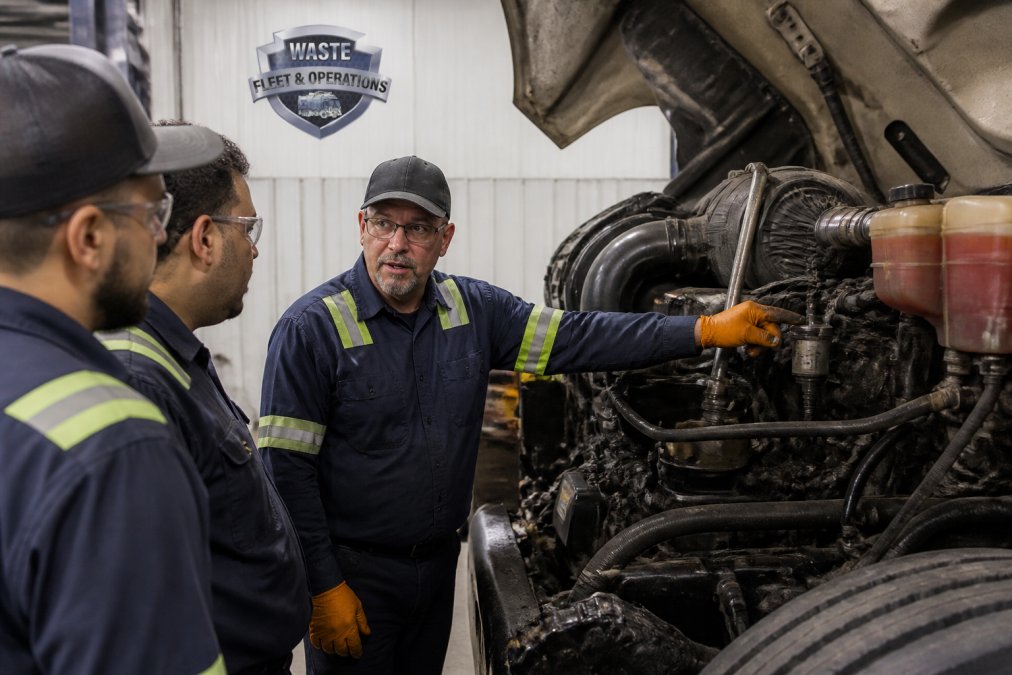
Many drivers don't receive formal training on what to look for or how to report problems. They assume maintenance is someone else's job. Change that mindset.
Driver training must cover:
- Daily pre-shift inspection checklist
- What warning lights and sounds mean
- How to report mechanical issues clearly and immediately
- Proper loading techniques to avoid overloading and stress on hydraulics
- Fuel-efficient driving that reduces engine strain
- Proper tire pressure and brake system checks
Telematics and Predictive Analytics: Stop Guessing, Start Preventing
Telematics systems collect real-time data from your trucks: engine performance, fuel consumption, idle time, harsh braking, speed, and location. Predictive analytics uses that data to forecast failures before they happen.
In-House Repair vs. Outsourced Maintenance: The Total Cost of Ownership Calculation
Every fleet manager faces this decision: maintain trucks in-house or contract with an outside service provider.
Calculate total cost of ownership by comparing:
- Labor cost per hour (in-house technician salary vs. outsourced rate)
- Parts markup (in-house purchasing vs. outsourced markup)
- Shop overhead (rent, utilities, tools, equipment)
- Downtime cost (how quickly each approach gets trucks back on route)
- Training and certification costs
Inventory Management and Parts Procurement Strategy
Parts availability determines how fast you can repair a truck. A broken water pump that could be fixed in 2 hours becomes a 2-day repair if you don't have the part in stock.
Parts procurement best practices:
- Maintain a minimum stock of high-failure items (oil, filters, hoses, belts, brake pads)
- Use demand forecasting to order parts before you run out
- Track supplier lead times and adjust inventory accordingly
- Negotiate volume pricing with primary suppliers
- Document every part failure to identify trends
Frequently Asked Questions
What are the most effective strategies for reducing waste truck maintenance costs?
The most effective strategies combine preventive maintenance, driver training, and data-driven decision-making. Scheduled maintenance on hydraulic systems, brake inspections, and fluid analysis prevents costly breakdowns. Telematics monitoring identifies component failures before they happen. Driver training reduces fuel consumption and wear on critical systems. Together, these approaches typically reduce maintenance costs by 30-50% within the first year while cutting breakdowns by 40-50%.
How much should I expect to reduce downtime with a preventive maintenance program?
Fleet managers implementing structured preventive maintenance programs typically see road call reductions of 50% or more. Daily breakdowns often drop by 25-50%, depending on your starting point and how consistently you follow the maintenance checklist. The key is consistency: scheduled maintenance on all vehicles according to manufacturer intervals, combined with driver training and telematics monitoring, creates compounding benefits over 3-6 months.
What's included in a preventive maintenance checklist for refuse trucks?
A comprehensive checklist covers hydraulic system inspections, fluid analysis, tire rotation and pressure checks, brake system inspections, engine oil and filter changes, coolant levels, hose condition, battery testing, and lights. Refuse trucks also require specific attention to the compactor mechanism, hopper hydraulics, and lift gate operation. The frequency depends on vehicle age and hours of operation, but most items are checked monthly or quarterly.
How can telematics help reduce diesel engine maintenance costs?
Telematics monitors engine performance in real-time, flagging issues like abnormal fuel consumption, excessive idling, hard braking, and component stress before they cause failure. This predictive data lets you schedule maintenance proactively rather than reactively. You can also identify driver behaviors that increase wear, enabling targeted training. Fleets using telematics typically extend component life by 15-25% and avoid 40-50% of unexpected breakdowns.