 blog
blog
Waste Fleet Due Diligence Checklist 2026
Table of Contents
- What Waste Fleet Due Diligence Actually Covers
- Vehicle Condition and Asset Verification
- Fleet Maintenance Audit Checklist: What to Inspect
- Regulatory Compliance and Environmental Liability
- Waste Management Business Valuation Metrics
- Waste Hauling Acquisition Risk Assessment Framework
- Route Economics and Fleet Fit
- Red Flags and Deal Decision Criteria
- Frequently Asked Questions
Last Updated: October 9, 2026
What Waste Fleet Due Diligence Actually Covers
Waste fleet due diligence is the systematic evaluation of a waste management company's trucks, operations, and financial health before acquisition or major capital investment, covering vehicle inspection, maintenance history, regulatory compliance, and route economics.
Most buyers focus only on truck condition and miss the operational, financial, and regulatory liabilities buried in the details.
Waste Fleet & Operations helps private equity firms and waste haulers evaluate trucks during acquisitions.
Here's what a complete waste fleet due diligence checklist actually requires:
- Vehicle condition and asset verification
- Maintenance audit and defect resolution history
- Regulatory and environmental liability screening
- Route economics and fleet use analysis
Vehicle Condition and Asset Verification
Start with the trucks. Every vehicle needs a truck-by-truck assessment beyond a visual walk-around.
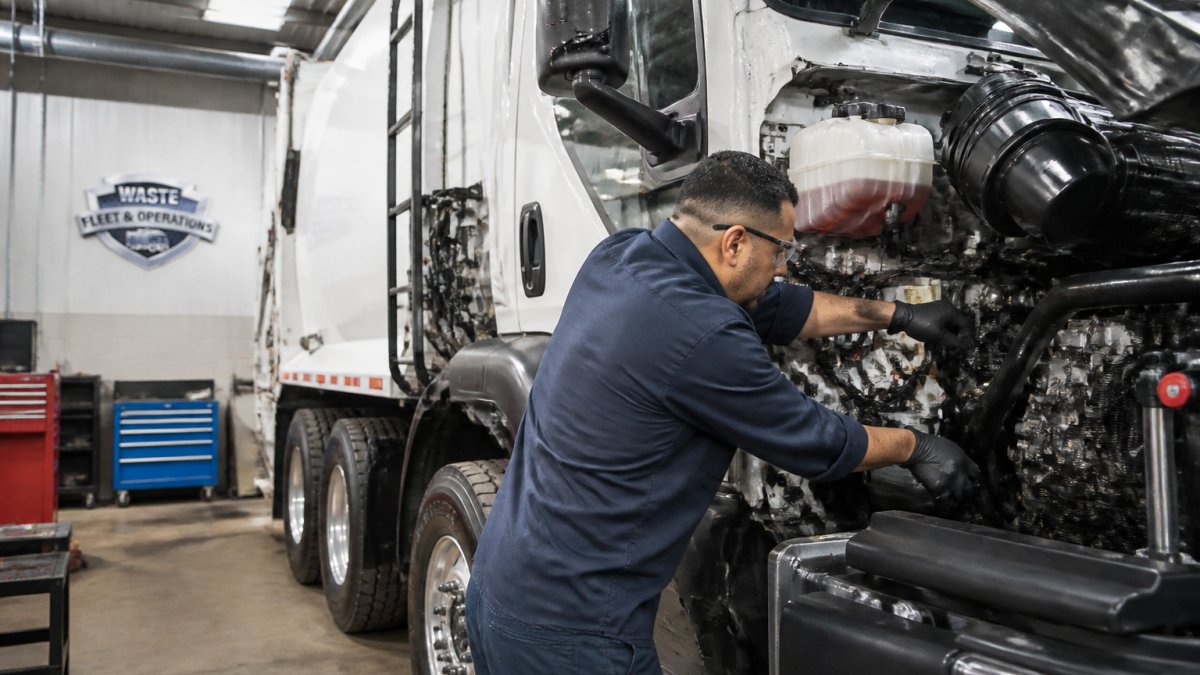
A proper vehicle inspection includes:
- Engine and transmission: Run a compression test, check oil condition, verify transmission fluid color and smell
- Hydraulic systems: Inspect hoses for leaks, test pressure under load, check fluid levels and contamination
- Brakes and suspension: Test stopping distance, inspect pad thickness, check suspension components for cracks or wear
- Cab and frame: Document rust, structural damage, and interior condition
Create a standardized scoring sheet rating major systems 1-5 to baseline repair costs and remaining useful life.
Document warranty status on each vehicle.
Fleet Maintenance Audit Checklist: What to Inspect
A maintenance audit reconciles what the shop says happened, what the trucks show happened, and what the invoices prove happened.
Run the audit in four passes.
Pass 1, Pull the records. Request the full maintenance file for every unit, not a sample. For each truck you want:
- Preventive maintenance (PM) service tickets with date, odometer, engine hours, and technician sign-off
- Repair orders for unscheduled work, including the complaint, cause, and correction
- Parts invoices tied to each repair order
- Warranty claims and any denied claims
- Outside vendor invoices (dealer, mobile mechanic, hydraulic specialist)
Pass 2, Reconcile records against the trucks. Pick at least five units across the age range and verify on the truck what the paperwork claims.
Pass 3, Score the maintenance backlog. Every deferred item is a future invoice. Build a line-item backlog:
| Backlog item | How to size it |
|---|---|
| Overdue PM services | Count units past interval × average PM cost |
| Open repair orders not completed | Sum quoted parts and labor |
| Known defects flagged but not repaired | Get written estimate from an independent shop |
| Tires below replacement threshold | Count positions × current tire price |
| Hydraulic hose and cylinder wear | Inspect and estimate per unit |
| Brake and suspension wear | Measure and estimate per unit |
Total the backlog and divide by fleet size. That is your maintenance liability per truck.
Pass 4, Test the program, not just the history. Ask the maintenance director to show you:
- The PM interval schedule by truck class and how it was set
- Whether technicians close work orders in real time or at week's end
- How DOT inspection defects are tracked to closure
- Whether the shop uses OEM service information or generic intervals
- How they decide repair versus replace on major components
Benchmarks to compare against. Most waste fleets run PM every 250 to 300 engine hours or every 8 to 12 weeks, whichever comes first. Rear-load and side-load packer bodies need hydraulic inspection at every PM and full fluid analysis annually. A fleet well above its peer group on maintenance cost per mile is over-maintaining, under-maintaining, or running equipment past its economic life.
Regulatory Compliance and Environmental Liability
Waste fleet operations sit at the intersection of DOT regulations, EPA rules, and state licensing requirements. Missing compliance creates deal-killing liability.
Your regulatory audit must verify:
- DOT compliance: Every truck must pass annual DOT inspections. Request inspection records for the past three years. Any failed inspections require repair documentation.
- Driver qualifications: Verify that all drivers hold valid commercial driver's licenses with proper endorsements. Check medical certifications and hours-of-service compliance.
- Hazardous waste handling: If the fleet handles any hazardous materials, verify proper training, placarding, and documentation.
- Environmental permits: Confirm the company holds all required state and local waste collection permits. Check for any violations or enforcement actions.
- Insurance coverage: Verify general liability, pollution liability, and workers' compensation coverage. Check for any claims history.
A third-party environmental consultant can identify permit gaps, training deficiencies, and environmental liabilities you might miss.
Check state environmental agency records for violations at the company's disposal facilities or transfer stations. Environmental liens can survive acquisition and become your problem.
Waste Management Business Valuation Metrics
Waste fleet valuation is not truck count times book value. It's a normalized earnings exercise where the fleet drives most cost, capital, and risk.
Start with normalized operating cost. Request 36 months of fleet-level P&L detail, then adjust:
- Replace above-market owner compensation with a market salary for the role performed
- Remove one-time legal, consulting, or transaction costs
- Amortize the maintenance backlog you sized in the audit over 12 months
- Normalize fuel using current local diesel prices on actual gallons consumed, not the seller's contracted rate
- Normalize insurance to current market premiums for the fleet's loss history and class codes
The result is a fleet-level EBITDA that reflects what you will actually experience, not what the seller reported.
Key metrics and how to read them.
| Metric | How to calculate | What a healthy range looks like | Red flag |
|---|---|---|---|
| Cost per collection | Total fleet operating cost ÷ total collections in period | Stable or declining year over year | Rising faster than route rate increases |
| Maintenance cost per truck | Annual maintenance spend ÷ average fleet count | Consistent with peer group for age and body type | Spikes in the trailing 12 months |
| Maintenance cost per mile | Annual maintenance ÷ annual miles | Lower on newer units, rising predictably with age | Flat cost on an aging fleet (suggests deferral) |
| Downtime percentage | Unit-days out of service ÷ unit-days available | ||
| Route completion rate | Routes completed as scheduled ÷ routes scheduled | ||
| Fuel cost per route | Fuel spend ÷ routes run | Tracks route density and truck class | Unexplained variance across similar routes |
| Revenue per truck | Route revenue ÷ truck count | Grows with rate increases and density | Flat while costs rise |
| Capital intensity | Annual capex ÷ revenue | Predictable replacement cycle | Lumpy, deferred, or absent |
Build the replacement reserve. This is the number most buyers get wrong. For each unit, estimate remaining useful life from age, engine hours, body condition, and maintenance backlog, then build a 60-month replacement schedule:
Book My Complimentary Discovery Call →
- List every unit with its estimated replacement year
- Apply current replacement cost for the same class and body type
- Subtract estimated salvage or trade-in value
- Sum the net capital requirement by year
Normalize route economics. Fleet value depends on the routes the trucks serve.
Adjust for contract and customer concentration. Review the top 20 customers by revenue, noting expiration dates, auto-renewal terms, rate escalators, and assignability on change of control.
Translate findings into an adjusted price. A practical approach:
- Start with normalized fleet-level EBITDA and apply a market multiple for waste services.
- Subtract the maintenance backlog you sized in the audit.
- Subtract the net present value of the 60-month replacement reserve above what the seller's historical capex would cover.
- Subtract the cost to remediate any compliance or environmental findings.
- Subtract the revenue at risk from contracts expiring within 12 months, weighted by renewal probability.
- Add back the value of any transferable warranties, permits, or long-term disposal agreements.
Waste Hauling Acquisition Risk Assessment Framework
Use this framework to score acquisition risk and inform your offer price.
Create a risk matrix with four categories:
Asset Risk (truck condition):
- Score each truck 1-5 on age, hours, and inspection results
- Average the fleet score
Operational Risk (maintenance and reliability):
- Review two years of downtime trends
- Score whether downtime is improving or worsening
- Rising downtime suggests hidden mechanical problems or poor maintenance discipline
Compliance Risk (regulatory exposure):
- Any failed DOT inspections in the past year = high risk
- Any environmental violations = very high risk
- Missing permits or training documentation = medium risk
Financial Risk (route economics):
- Compare the company's cost per collection to industry benchmarks
- Declining route density = declining profitability
Assign a risk score: 1 (low) to 5 (high) for each category.
Route Economics and Fleet Fit
A truck's value depends on the routes it serves, a perfectly maintained truck on a declining route generates no profit. Analyze route economics by examining:
- Route density: Collections per mile per day
- Customer retention: Percentage of customers renewing annually
- Contract terms: Long-term fixed prices, or rates that adjust annually?
- Seasonal variation: Spring/summer peaks, or stable year-round?
Map all routes geographically. Dense routes served by one truck are more profitable: 40 collections in a 15-mile radius is worth far more than 40 spread across 50 miles.
Calculate "fleet fit" by matching truck capacity to route demand.
Waste Fleet & Operations helps clients model route profitability before acquisition. Knowing which routes drive profit and which drain cash changes how you value the entire fleet.
Red Flags and Deal Decision Criteria
Stop the deal if you find any of these:
Immediate deal-killers:
- Failed DOT inspections in the past year without documented repairs
- Environmental violations or cleanup orders
- Missing commercial driver's licenses or medical certifications
- Maintenance records that don't match truck condition (records show regular service but trucks are falling apart)
- Sudden spike in downtime or major repairs in the past 12 months
Major concerns (require significant price adjustment):
- Average truck age above 12 years
- Maintenance costs above $15,000 per truck annually
- Use below 80%
- More than 10% of routes under contract expiration within 12 months
- No preventive maintenance program or digital tracking system
Minor concerns (monitor but don't kill the deal):
- Aging fleet but stable maintenance costs
- One or two routes with below-average density
- Recent management turnover with documented transition plan
- Pending equipment upgrades already budgeted
The decision framework is simple: can you improve this operation within 12 months, and at what cost?
Conducting a proper waste fleet due diligence assessment takes time, but it prevents costly surprises after closing. Successful acquirers verify every truck, understand every route, and price the deal around actual operating reality, not optimistic projections. Waste Fleet & Operations can guide you through this process with a structured approach tailored to your operation.
Frequently Asked Questions
What are the key operational risks when acquiring a waste fleet?
The biggest operational risks include hidden maintenance liabilities, driver safety violations, poor route density affecting profitability, and undisclosed environmental compliance failures. A truck with deferred maintenance can lead to significant repair costs within months. Environmental violations carry regulatory fines and liability exposure. Assess maintenance records, driver incident history, route utilization, and environmental audit reports before closing. A waste fleet due diligence checklist identifies these risks before they become post-acquisition problems.
How should I evaluate waste management business valuation metrics during due diligence?
Focus on normalized operating costs, fleet utilization rates, revenue per route, and customer contract stability. Calculate cost per collection, maintenance spend as a percentage of revenue, and fuel efficiency by vehicle type. Compare these metrics against industry benchmarks. Look at customer concentration, if one contract represents more than 30% of revenue, that's high risk. Review 3 years of financial data to identify trends. Environmental liabilities and pending compliance issues can reduce valuation, so factor those into your assessment.
What should a fleet maintenance audit checklist include during acquisition due diligence?
Your fleet maintenance audit checklist must verify maintenance records completeness, warranty status on critical components, inspection failure history, preventive maintenance compliance, and technician certifications. Document each truck's engine hours, transmission condition, hydraulic system status, brake and electrical systems, and body/container condition. Check for recalls, open service bulletins, and deferred repairs. Assess whether maintenance was performed on schedule or reactive. Poor maintenance records indicate higher post-acquisition breakdown risk and suggest operational dysfunction.
How does environmental compliance impact waste fleet valuation and risk?
Environmental compliance failures can reduce fleet valuation and create ongoing liability. Verify EPA and DOT compliance status, emission standards adherence, hazardous waste handling procedures, and spill/contamination history. Check for pending violations, fines, or remediation orders. Assess whether the fleet meets current emissions standards and whether vehicles will require costly upgrades. Environmental due diligence protects you from inheriting cleanup costs, regulatory penalties, and operational shutdowns. This is non-negotiable in waste fleet acquisitions.