 how-to
Small Waste Fleet Operational Improvements: A Practical Guide
Table of Contents
- Why Small Waste Fleets Struggle with Operational Efficiency
- Step 1: Establish Your Baseline Metrics and Waste Management Operational KPIs
- Step 2: Implement Waste Fleet Maintenance Best Practices
- Step 3: Optimize Routes with Waste Collection Route Optimization Software
- Step 4: Address Driver Behavior and Safety
- Step 5: Manage Change and Build Adoption
- Common Mistakes to Avoid
- Frequently Asked Questions
Last Updated: October 7, 2026
Why Small Waste Fleets Struggle with Operational Efficiency
Small waste fleets can't absorb problems through scale.
The core issue isn't complexity, it's visibility.
This is where small waste fleet operational improvements become essential. You don't need enterprise software or a team of analysts, just a practical roadmap.
At Waste Fleet & Operations, we work with waste haulers of all sizes.
Step 1: Establish Your Baseline Metrics and Waste Management Operational KPIs
You can't improve what you don't measure. The first step in waste fleet operational improvements is defining which metrics matter, pick the ones that directly affect your bottom line and your ability to serve customers reliably.
Core KPIs to Track
Start with these four foundational metrics:
Daily breakdown rate. How many trucks fail to complete routes each week? This is your most expensive metric, every breakdown triggers service calls, complaints, and overtime. Track it as a weekly count: "3 breakdowns last week" is actionable; "a 5% rate" is vague.
Fuel consumption per route. Gallons used divided by miles driven.
On-time service completion. What percentage of scheduled pickups happen on the promised day? Missed pickups damage relationships and trigger service credits.
Preventive maintenance compliance. What percentage of scheduled maintenance gets done before a breakdown? Below 70% means you're running mostly reactive.
Setting Up Simple Tracking
You don't need software to start, a shared spreadsheet works. Create columns for each metric, update weekly, and assign one owner. After four weeks you'll have a baseline.
Step 2: Implement Waste Fleet Maintenance Best Practices
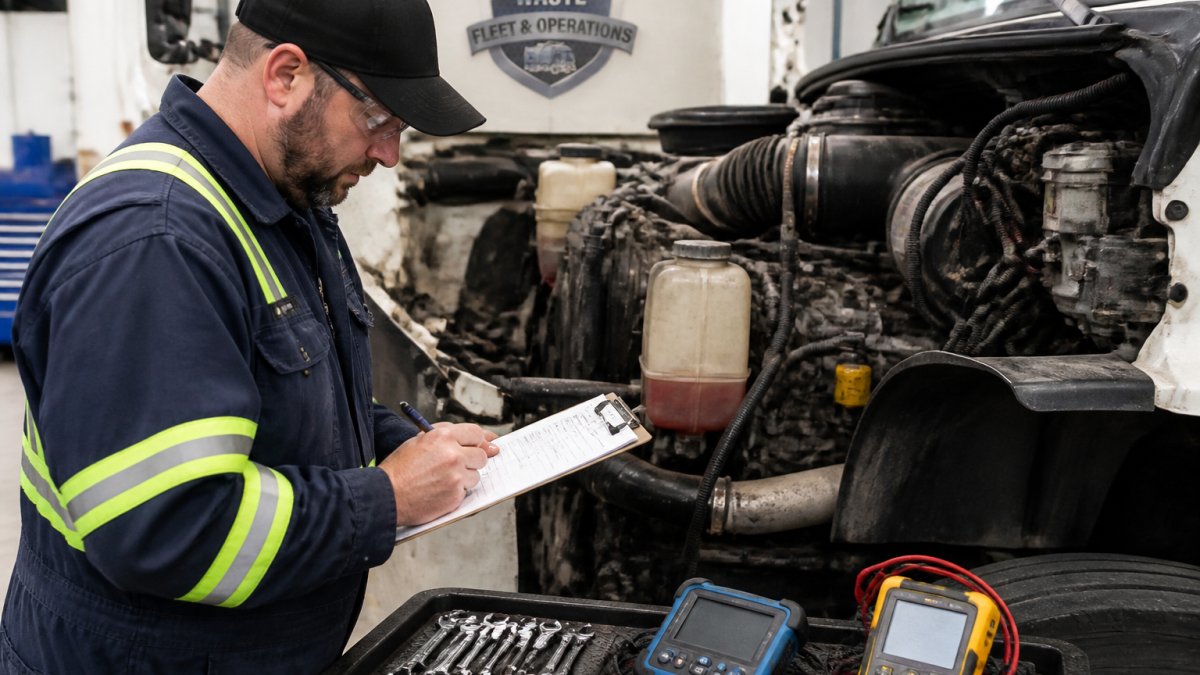
Preventive maintenance is a high-value improvement most small waste fleets can make, and the one most commonly skipped when you're busy. Reactive maintenance costs more: a road breakdown means a service call, towing, lost productivity, and customer impact.
Preventive Maintenance Planning
Build a maintenance schedule based on manufacturer recommendations and your fleet's actual usage patterns. Waste collection trucks run hard, frequent stops, heavy loads, dusty environments. They need more frequent maintenance than typical commercial vehicles.
Create a schedule that specifies:
- Oil and filter changes at manufacturer intervals
- Fluid checks (coolant, hydraulic, transmission) monthly
- Belt and hose inspections quarterly
Post the schedule where technicians see it and make it non-negotiable: when a truck comes in, the first question is "What maintenance is due?" Assign one technician to own it, tracking due dates, pulling trucks for service, documenting completion.
Driver Accountability and Vehicle Inspections
Your drivers are your eyes on the road. A daily pre-trip inspection catches small issues before they become breakdowns.
Create a simple inspection checklist:
- Fluid levels (oil, coolant, hydraulic)
- Tire condition and pressure
- Brake function
Drivers complete and sign off before each shift; if something's wrong, the truck doesn't leave. Bridge the shop-driver communication gap by explaining: a small issue reported today prevents a breakdown tomorrow.
Step 3: Optimize Routes with Waste Collection Route Optimization Software
Inefficient routes are invisible money drains: a truck taking 9 hours on a 6-hour route burns fuel, pays overtime, and delivers poor service. For a small fleet, the answer is rarely "buy the biggest routing platform", it depends on truck count, customer-base stability, and dispatcher time. Optimization reduces idle time, lowers fuel consumption, and makes schedules predictable, because a missed pickup on a tight route cascades into the next day.
Start with Free and Low-Cost Route Review Before Buying Software
Before evaluating any paid tool, do a manual route audit. Many small fleets find route time is recoverable through simple sequencing fixes.
A practical manual audit looks like this:
- Export or write down your stop sequence for one route.
- Note the arrival time at each stop for one full day.
- Mark backtracking (passing a street twice), long deadhead gaps (more than 10 minutes between stops), and stops that consistently run long.
- Re-sequence the obvious problems and re-run the route for a week.
- Compare miles driven, fuel used, and completion time against the prior week.
This mirrors commercial routing engines, just slower, and builds the baseline to judge whether paid software is worth it.
Matching the Tool to Your Fleet Size
Not every small fleet needs the same class of tool:
- 1-5 trucks, stable routes: A spreadsheet plus a mapping app is often enough. Focus on sequencing and time-of-day traffic patterns.
- 6-15 trucks, growing customer base: A mid-tier routing or dispatch tool with capacity constraints and driver mobile apps starts to pay for itself.
- 15-25 trucks, multiple service lines (residential, commercial, roll-off): Full routing optimization with vehicle capacity, time windows, and service-type rules becomes worth the cost.
When evaluating software for waste collection route optimization, look for tools that import current routes and customer locations, identify inefficiencies (backtracking, long gaps), suggest optimized sequences, account for vehicle capacity, provide driver-friendly directions, and handle service-type differences (a roll-off stop is not a curbside stop). The best tools highlight opportunities rather than replace your judgment, override suggestions that fail because of a one-way street or a customer relationship.
Book My Complimentary Discovery Call →
Prioritize by Payback, Not by Feature List
Rank route changes by impact (miles or minutes saved per week), effort (hours to implement), and payback (weeks until savings cover the cost). A change saving 30 minutes a day on one route with two hours of setup can be more effective than a fleet-wide rollout taking three months to configure.
Balancing Technology with Driver Input
Many implementations fail because managers roll out optimized routes without explaining why or asking for feedback, and drivers resist because they know their territory and weren't consulted. The fix: involve drivers, show them the data, ask where the software got it wrong, and adjust together, drivers who help design a route are far more likely to follow it.
Trade-Off: Process Change vs. Paid Telematics
A common small-fleet decision is routing software versus telematics. They solve different problems: routing software reduces miles and time, while telematics cuts fuel waste from idling and harsh driving and surfaces maintenance signals.
Step 4: Address Driver Behavior and Safety
Driver behavior directly affects fuel costs, maintenance, and safety, hard acceleration, aggressive braking, and speeding all increase wear and fuel consumption.
Use telematics or basic vehicle monitoring to track harsh braking, rapid acceleration, and speeding, then share the data as coaching, not discipline: "You had 8 hard braking events this week.
Step 5: Manage Change and Build Adoption
The best operational improvements fail if people don't adopt them, and most small operations underestimate this. Small fleets don't need abstract change management, they need a phased rollout with named owners, checkpoints, and a way to handle resistance from a stretched team.
A 90-Day Rollout You Can Actually Run
You don't need a transformation office. You need one owner per workstream and a weekly 15-minute check-in. A practical 90-day plan:
Days 1-30, Baseline and buy-in.
- Owner: Operations manager.
- Actions: Track the four core KPIs weekly. Hold a 30-minute all-hands to share the baseline and ask drivers and technicians what the biggest problems are.
- Checkpoint: Four weeks of baseline data and a written list of team-identified pain points.
Days 31-60, Pilot one or two changes.
- Owner: Maintenance lead for PM schedule; dispatcher for route pilot.
- Actions: Implement the PM schedule on half the fleet, pilot route changes on two routes, and train drivers on the new pre-trip checklist.
- Checkpoint: Compare pilot results against baseline; expand, adjust, or stop.
Days 61-90, Expand and standardize.
- Owner: Operations manager, with workstream leads.
- Actions: Roll successful changes fleet-wide, update written procedures, and set the review cadence (weekly KPI update, monthly team review).
- Checkpoint: Improvements are documented, owned, and repeatable without the original champion.
Bridging the Shop Floor and Management Gap
The shop-management communication gap is real at small operations: technicians feel management doesn't understand how hard maintenance is, while management feels technicians don't care about efficiency or cost control. Close it with visibility and dialogue, share baseline metrics with the whole team, show breakdowns as they happen, and ask technicians and drivers for input on schedules and routes.
Handling Resistance Without Turning It Into a Fight
Resistance is normal and usually comes from fear of blame, skepticism that the change will stick, or genuine disagreement. Address each differently:
- Fear of blame: Frame metrics as diagnostic, not disciplinary. "We're tracking breakdowns to find the cause, not a culprit."
- Skepticism: Show a small win early, a route finishing 45 minutes earlier persuades better than a slide deck.
- Genuine disagreement: Ask the resister to help design the fix; the driver who thinks the new route is wrong often has the local knowledge to make it right.
Training When You Don't Have a Trainer
Small fleets rarely have a dedicated training budget or staff. Use the people you have:
- Pair a skeptical veteran with a driver who already likes the new process. Peer influence beats management mandates.
- Keep training to 15-20 minutes at shift start, not a half-day off-site.
- Write a one-page checklist for each new process. If it doesn't fit on one page, it's too complex to stick.
Tracking Progress and Adjusting
After implementing changes, track progress against baseline metrics, review monthly with your team, celebrate wins, and adjust what isn't working. "We reduced breakdowns from 3 per week to 1" and "fuel consumption dropped 8%" are concrete wins worth sharing, they build momentum. Be willing to adjust: if a new route doesn't work, change it; if a maintenance schedule is too aggressive for shop capacity, modify it.
Contingency Planning for Breakdowns and Staffing Gaps
Small fleets have little slack, one truck down or one driver out can break the day. Build a contingency plan before you need it:
- Identify spare capacity. Do you have a backup truck, or can you rent one on short notice?
- Cross-train drivers. At least two should be able to cover each route.
- Pre-qualify a towing and mobile repair vendor. Have the number saved and terms understood.
This resilience layer doesn't show up in efficiency metrics, but it keeps a small fleet's reputation intact when something goes wrong.
Common Mistakes to Avoid
Not measuring before you start. Without a baseline you can't tell if improvements work.
Implementing technology without training. Software doesn't improve operations by itself.
Ignoring driver and technician input. These people know your operation better than any consultant.
Confusing activity with results. Doing more maintenance isn't the goal. Reducing breakdowns is.
Frequently Asked Questions
How can small waste haulers reduce fleet maintenance costs?
Small waste fleets reduce maintenance costs by shifting from reactive repairs to preventive maintenance. Track vehicle diagnostics, schedule regular inspections before breakdowns occur, and empower drivers to report issues early. Preventive planning can reduce emergency road calls, cutting both repair expenses and lost productivity. Start by documenting your current breakdown frequency and maintenance spend, this baseline shows where savings are possible.
What waste management operational KPIs should we track first?
Begin with three core KPIs: daily breakdowns per vehicle, fuel consumption per ton collected, and route completion rate. These metrics reveal immediate pain points and show ROI from improvements. Track them weekly using simple spreadsheets or fleet management software. Many small fleets find that monitoring these three metrics alone identifies operational waste, from idle time to missed pickups to preventable maintenance failures.
Do waste collection route optimization tools actually work for small fleets?
Yes, but approach them as a starting point, not a replacement for driver knowledge. Route optimization software can improve density and reduce fuel costs, but small fleets often see better results by combining software recommendations with driver input. Drivers know which stops have access issues or tight schedules that algorithms miss. The best practice is to test optimized routes on 2-3 vehicles first, measure results, then roll out to the full fleet.
How long does it take to see improvements from operational changes?
Baseline metrics and preventive maintenance planning show measurable improvements within 4-6 weeks. Route optimization typically shows fuel savings within 2-3 weeks. However, sustainable culture change, where drivers and technicians consistently apply best practices, takes 3-4 months to stabilize. Many small fleets see reductions in daily breakdowns within the first year when they address maintenance, routes, and driver behavior together.