 how-to
How to Reduce Waste Truck Downtime: 7 Proven Steps
Table of Contents
- Step 1: Build a Preventive Maintenance Checklist for Refuse Trucks
- Step 2: Set Waste Truck Driver Pre-Trip Inspection Best Practices
- Step 3: Use Waste Fleet Maintenance Software and Telematics Data
- Step 4: Reduce Unexpected Breakdowns With Digital Vehicle Inspections
- Step 5: Plan for Parts Supply Chain and Technician Shortages
- Step 6: Reduce Fleet Maintenance Costs Without Cutting Corners
- Step 7: Measure Progress and Avoid Common Downtime Mistakes
- Frequently Asked Questions
Last Updated: September 21, 2026
Step 1: Build a Preventive Maintenance Checklist for Refuse Trucks
Your PM program should cover seven core elements:
- Hydraulic fluid and filter changes on a fixed interval
- Brake adjustment and pad thickness checks
- Tire pressure, tread depth, and rotation
- Engine oil and filter service by engine hours, not just miles
- Coolant and transmission fluid levels
- Packer blade and cylinder inspection
- Chassis lubrication and fastener torque checks
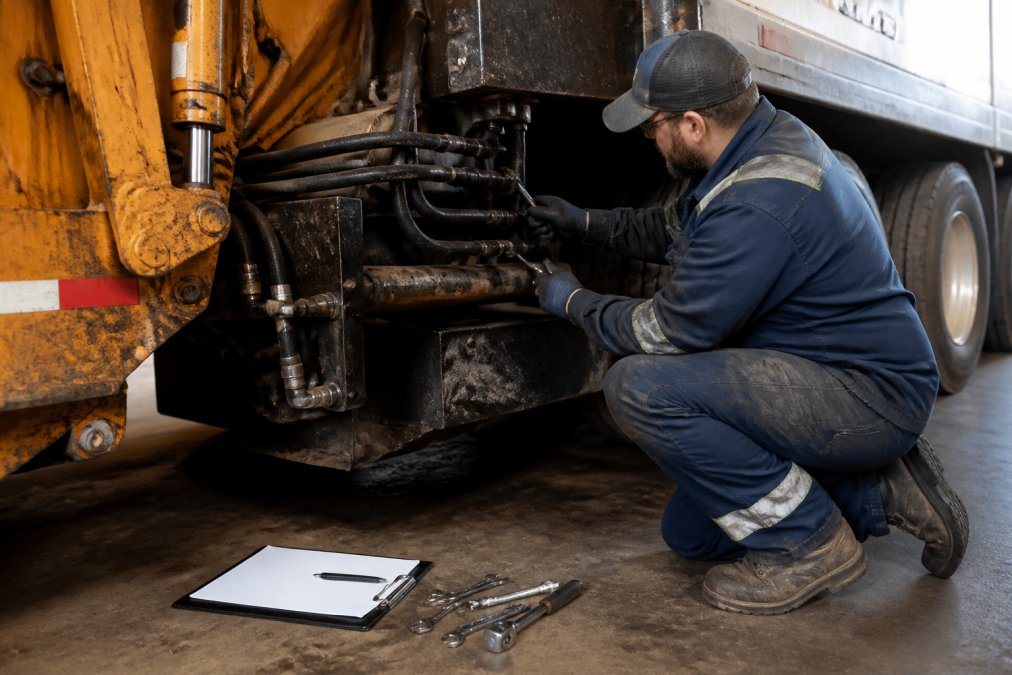
The 7 Elements of a Refuse Truck PM Program
Each element gets a set interval and a named owner.
- Hydraulic system service
- Brake and air system inspection
- Tire and wheel-end checks
- Engine and drivetrain fluids
- Packer and body mechanism review
- Electrical and lighting test
- Cab, safety, and compliance items
Hydraulic System Monitoring: The Failure Point Most Fleets Miss
Hydraulic systems cause more unplanned refuse truck downtime than almost any other component. The packer, lift arms, and tailgate depend on pressurized fluid, and heat breaks it down.
Watch three things:
- Fluid temperature during heavy routes
- Filter restriction indicators
- Cylinder rod condition and seal leaks
Step 2: Set Waste Truck Driver Pre-Trip Inspection Best Practices
Waste truck driver pre-trip inspection best practices start with a short, repeatable routine drivers can finish in about ten minutes, catching small problems before they become road calls.
Build a pre-trip routine around these checks:
- Walk-around for leaks, damage, and tire condition
- Brake test and air pressure check
- Hydraulic function test on the packer
- Lights, mirrors, and backup alarm
- Fluid level spot checks
Brake and Tire Inspection Protocols Drivers Can Complete in 10 Minutes
Brake and tire problems cause a large share of unexpected breakdowns, and a quick driver-level check catches most early.
Here's a ten-minute protocol:
- Check tire pressure and look for cuts or bulges (2 minutes)
- Inspect tread depth on all positions (2 minutes)
- Listen for air leaks after shutdown (2 minutes)
- Test brake response at low speed (2 minutes)
- Note anything unusual on the report (2 minutes)
Step 3: Use Waste Fleet Maintenance Software and Telematics Data
Waste fleet maintenance software turns paper logs and guesswork into scheduled, trackable work. Paired with telematics, it becomes a predictive maintenance tool.
Together they let you:
- Trigger service alerts by engine hours or fault codes
- Track repair turnaround by unit
- See which trucks cost the most to run
- Plan parts before a job starts
Turning Fault Codes and Telematics Into Predictive Maintenance
- Aftertreatment and DPF codes. A rising frequency of active regeneration events, or repeated derate codes tied to the diesel particulate filter, almost always means the truck is doing too much stop-and-go work to complete a passive regen. Left alone, it ends in a forced regen or a parked truck. Watch regen frequency per engine hour, not just the code itself.
- EGR and intake codes. EGR valve position faults and intake manifold pressure deviations show up long before the driver feels a power loss. On a packer that idles between stops, soot loading accelerates.
- Cooling system codes. Coolant temperature deviation codes on a refuse truck usually trace back to a fan clutch, a plugged radiator from route debris, or a thermostat that never fully opens. Any of those will cook hydraulic fluid on a hot day.
- Transmission and torque converter codes. Stop-and-go collection is brutal on the torque converter and retarder. Slip codes and over-temperature events are early warnings, not nuisances.
- ABS and air system codes. Wheel speed sensor faults and low air pressure warnings are the leading edge of brake and tire failures.
Set up your system to:
- Flag repeat fault codes for review inside a rolling window, not one at a time
- Alert on abnormal idle time and engine temperature trends, not just thresholds
- Track hard braking and harsh driving by driver, tied to the unit
- Feed every confirmed pattern back into the PM schedule as a new trigger
Interpretation matters more than the data, and someone has to own it, on well-run waste fleets, a maintenance planner, not a shop foreman already under a truck.
Step 4: Reduce Unexpected Breakdowns With Digital Vehicle Inspections
Digital vehicle inspections replace paper forms with guided tablet or phone checklists: techs and drivers follow prompts, attach photos, and submit results instantly.
Key benefits for a waste fleet:
- Photo evidence of defects
- Timestamped records for compliance reporting
- Instant alerts to the shop
- Searchable history per vehicle
Step 5: Plan for Parts Supply Chain and Technician Shortages
Parts availability and technician shortages are the two constraints most fleets underestimate, stretching repair turnaround and quietly raising operational costs. Most guides treat these as procurement and HR problems; on a waste fleet they are downtime problems, planned for like maintenance.
Which Parts Actually Go on Backorder
Not every part is a supply risk. The ones that park trucks are the ones with long lead times, single-source suppliers, or both. In practice, the high-risk list on a refuse fleet looks like this:
-
Packer-specific components. Tailgate cylinders, packer blades, and body-specific hydraulic valves are often built to the body manufacturer's spec, not stocked at a local dealer. A blown tailgate cylinder can mean weeks, not days.
-
Proprietary electronics. Body control modules, joystick controllers, and CAN bus harnesses for the packer body are frequently single-source. A failed controller can idle a truck while the chassis is perfectly healthy.
-
Aftertreatment components. DPFs, DEF pumps, and NOx sensors have been the most consistently constrained diesel parts in recent years across most manufacturers.
-
Transmission and retarder parts. Reman units and internal hard parts for the transmissions used in stop-and-go collection are frequently on allocation.
-
Tires in odd sizes. Front and rear positions on a refuse truck often use sizes a general tire distributor does not keep on the shelf.
-
Stock high-failure, long-lead items before you need them, cylinders, controllers, sensors, and one spare of each critical hydraulic valve
-
Track actual lead times, not catalog lead times, and update them quarterly
-
Qualify at least two suppliers for every critical part, including one aftermarket source where warranty allows
-
Standardize bodies and chassis across the fleet so one spare fits more trucks
-
Build a cannibalization policy in writing, so a dead truck becomes a parts donor on a schedule instead of by argument
Managing Around the Diesel Technician Shortage
Skilled diesel technicians, especially those who understand hydraulic packer systems and aftertreatment diagnostics, are hard to find and keep. Waiting for the market to fix itself is not a plan; fleets that hold turnaround times do three things differently.
- Pair junior techs with experienced mentors on live repairs, not simulations
- Train on your actual trucks and body styles, not generic curriculum
- Document root cause analysis so lessons survive turnover
- Cross-train drivers on basic diagnostics and fault-code reporting
- Track technician time by repair type to find where your senior techs are being wasted
Step 6: Reduce Fleet Maintenance Costs Without Cutting Corners
Reducing fleet maintenance costs works best when you cut waste, not maintenance. Skipping service saves money today and pays for it with a breakdown tomorrow.
Real savings come from prevention:
- Fix root causes, not symptoms
- Track cost per mile and cost per unit
- Retire trucks past their useful lifecycle
- Cut unnecessary idling to reduce wear and fuel use
Step 7: Measure Progress and Avoid Common Downtime Mistakes
Measure progress with a handful of clear numbers. If you can't measure it, you can't improve it.
Track these each month:
- Breakdowns per truck
- Road calls per month
- Repair turnaround time
- PM compliance rate
- Cost per mile
| Mistake | Fix | Impact |
|---|---|---|
| PM by mileage only | Schedule by engine hours | Catches hydraulic wear |
| Paper inspections | Digital inspections | Fewer missed defects |
| Ignoring fault codes | Assign an owner | Early fault detection |
| No parts stock | Plan high-failure items | Faster repairs |
| Weak driver reporting | Simple red-yellow-green forms | Better early warnings |
Frequently Asked Questions
What are the most common causes of unplanned waste truck downtime?
Hydraulic system failures, brake and tire wear, and engine faults top the list. Refuse trucks run hundreds of compaction cycles per shift, which wears hydraulic hoses, cylinders, and pumps faster than most heavy-duty vehicles. Brake and tire problems follow closely because stop-and-go collection routes put constant stress on those components. Many of these failures show warning signs weeks earlier through fault codes, fluid analysis, or driver reporting, but only if your fleet captures that data and acts on it.
How does preventive maintenance impact the total cost of ownership for refuse trucks?
Preventive maintenance extends vehicle lifecycle by catching small failures before they become major repairs. A hydraulic hose replaced on schedule costs far less than a pump destroyed by contamination or a truck towed mid-route. Fleets that follow a structured preventive maintenance checklist for refuse trucks typically see fewer road calls, shorter repair turnaround, and better resale value. Over a 7-10 year truck lifecycle, those savings compound into six figures per vehicle, which is why reducing fleet maintenance costs starts with prevention, not repair.
How can telematics data be used to predict mechanical failures in waste vehicles?
Telematics platforms track fault codes, engine hours, idle time, and component performance in real time. When a truck logs repeated fault codes or shows abnormal idle patterns, that data flags a component heading toward failure. Pair telematics with driver reporting and digital inspections, and you get a fuller picture than any single source provides. The key is interpretation: raw data alone does not prevent breakdowns. Someone has to review trends weekly and schedule repairs before the truck fails on route.
What role does driver pre-trip inspection play in reducing fleet downtime?
Drivers are your first line of defense. A 10-minute pre-trip inspection catches low hydraulic fluid, worn brake pads, tire damage, and warning lights before the truck leaves the yard. When drivers report issues through a simple, consistent process, the shop can schedule repairs during planned downtime instead of reacting to a mid-route breakdown. Waste truck driver pre-trip inspection best practices work best when paired with a culture where reporting problems is expected, not punished.