 How-to
Are Waste Fleet Performance Improvement Programs Worth It?
Last Updated: November 4, 2026
Quick Summary
Waste fleet performance improvement programs are worth it when run as an ongoing practice, not a purchase, because they raise reliability, route efficiency, and cost control through data, maintenance discipline, and frontline training. Software shows you a problem; the program fixes it.
- Define each KPI with a baseline, target, owner, and monthly review cadence before the program starts.
- Pull twelve months of history, or run a 30-day measurement window, before setting any target.
- Start with five or six metrics mapped to first-year goals rather than a scorecard of twenty.
- Build the first-year cost stack to include internal labor and training time, which are often left out.
- Set a 90-day review date and watch PM compliance and fault resolution time as leading indicators.
Table of Contents
- What a Waste Fleet Performance Improvement Program Actually Delivers
- Waste Fleet Performance KPIs That Prove the Program Is Working
- Waste Fleet Preventive Maintenance: The Core of Any Program
- Where Waste Fleet Management Software Fits (and Where It Doesn't)
- Waste Fleet Maintenance Training That Sticks on the Shop Floor
- Program Economics: What the ROI Looks Like in Year One
- Book Your Complimentary Discovery Call
- Frequently Asked Questions
What a Waste Fleet Performance Improvement Program Actually Delivers
Most waste haulers do not need another dashboard. They need fewer breakdowns, fewer missed pickups, and a shop floor that talks to management. That is the promise behind waste fleet performance improvement programs, and it is worth testing against reality before you spend a dollar.
A waste fleet performance improvement program is a structured, ongoing effort to raise fleet reliability, route efficiency, and cost control using data, maintenance discipline, and frontline training. At Waste Fleet & Operations, we build these programs around one operation at a time, not a template.
Here is the distinction that matters. Software shows you a problem. A program fixes it. Many haulers buy a telematics platform and change little afterward. The program is the part that changes behavior.
What a working program typically delivers:
- Fewer unplanned breakdowns and road calls
- Lower maintenance spend through early fault detection
- Better route efficiency and on-time service
- Clearer communication between technicians and managers
Watch out: a common failure is treating a program as a purchase rather than a practice. A tool with no owner and no review cadence tends to fade.
Waste Fleet Performance KPIs That Prove the Program Is Working
You cannot manage what you do not measure, and you cannot defend a budget without numbers. But a list of formulas is not a scorecard.
The core metrics to track, with the formula and the decision each one drives:
| KPI | Formula | What It Tells You | Who Owns It |
|---|---|---|---|
| Road calls per 100 trucks | Road calls ÷ trucks × 100 | Breakdown frequency and dispatch strain | Shop lead |
| Mean distance between failures | Total miles ÷ failures | Vehicle health trend by unit and class | Maintenance manager |
| PM compliance rate | PMs completed on time ÷ PMs due | Maintenance discipline and schedule adherence | Shop lead |
| Idle time percentage | Idle hours ÷ engine hours | Fuel waste and driver behavior | Operations manager |
| Missed pickups per route | Missed stops ÷ scheduled stops | Service reliability and route design | Route supervisor |
| Cost per mile | Total operating cost ÷ miles | Overall efficiency across the fleet | General manager |
| Fuel per mile | Gallons consumed ÷ miles | Fuel efficiency independent of fuel price | Operations manager |
| Vehicle utilization | Productive hours ÷ available hours | Asset use and fleet right-sizing | Operations manager |
| Downtime hours per unit | Sum of out-of-service hours ÷ units | Availability and shop throughput | Maintenance manager |
Set a baseline first. Without a starting number, every later claim is a guess. Pull twelve months of history where you have it, and where you do not, run a 30-day measurement window before you set a single target.
Benchmarking is where many programs stall. Reliable cost-per-mile or road-calls-per-100-trucks figures vary by fleet segment, so benchmarks should be built with segment context. Build your benchmark from three sources instead: your own trailing twelve months, your best-performing route or depot, and a peer comparison you trust.
Set targets in bands rather than single numbers. A practical approach is to define a floor (current baseline), a target (a realistic 90-day move), and a stretch goal (what best-in-class looks like in your own operation). For PM compliance, many practitioners treat a rate well below full adherence as a leading indicator of rising road calls.
The second half of the discipline is cadence and data quality. Review the same dashboard on the same day each month, with the shop lead in the room. Metrics that nobody reviews are decoration.
Watch out: a scorecard with twenty metrics gets ignored. Start with five or six that map to the program's first-year goals, prove they move, then add the rest. If you want a fuller tracking method, our guide on how to track waste fleet maintenance KPIs walks through benchmarks and reporting.
Waste Fleet Preventive Maintenance: The Core of Any Program
Everything else in a program rests on preventive maintenance. If PMs slip, breakdowns rise, routes fail, and costs climb. No amount of route optimization survives a truck that will not start.
A sound waste fleet preventive maintenance schedule covers:
- Daily walk-around inspections by drivers
- Fluid, brake, and tire checks on a fixed interval
- Hydraulic and compactor system inspection
- Scheduled component replacement before failure
- Documented completion for every unit
The hard part is not the list. It is adherence under pressure. When routes run long, PMs get pushed. That is exactly when failures start.
For a deeper practical framework, see our guide to preventive maintenance strategies for sanitation trucks. It covers interval setting and documentation in more detail.
Consistent PM compliance and acting on early fault codes can reduce daily breakdowns. The gain comes from consistency, not from a new tool.
Where Waste Fleet Management Software Fits (and Where It Doesn't)
Waste fleet management software is genuinely useful. It captures vehicle locations, real-time tracking, fault codes, and driver behavior data. Telematics, IoT sensors, and AI dash cameras have made operational visibility far better than it was a decade ago.
Software is useful for tracking vehicle use, flagging fault codes, monitoring driver behavior, and supporting dispatch. It does not decide which faults need immediate attention, train a technician, or rebuild trust between the shop floor and management. Software works best as the sensor layer of a program, not the program itself.
Watch out: buying a platform before defining your KPIs usually produces a dashboard nobody opens. Define the metrics first, then choose the tool that reports them.
Book My Complimentary Discovery Call →
Waste Fleet Maintenance Training That Sticks on the Shop Floor
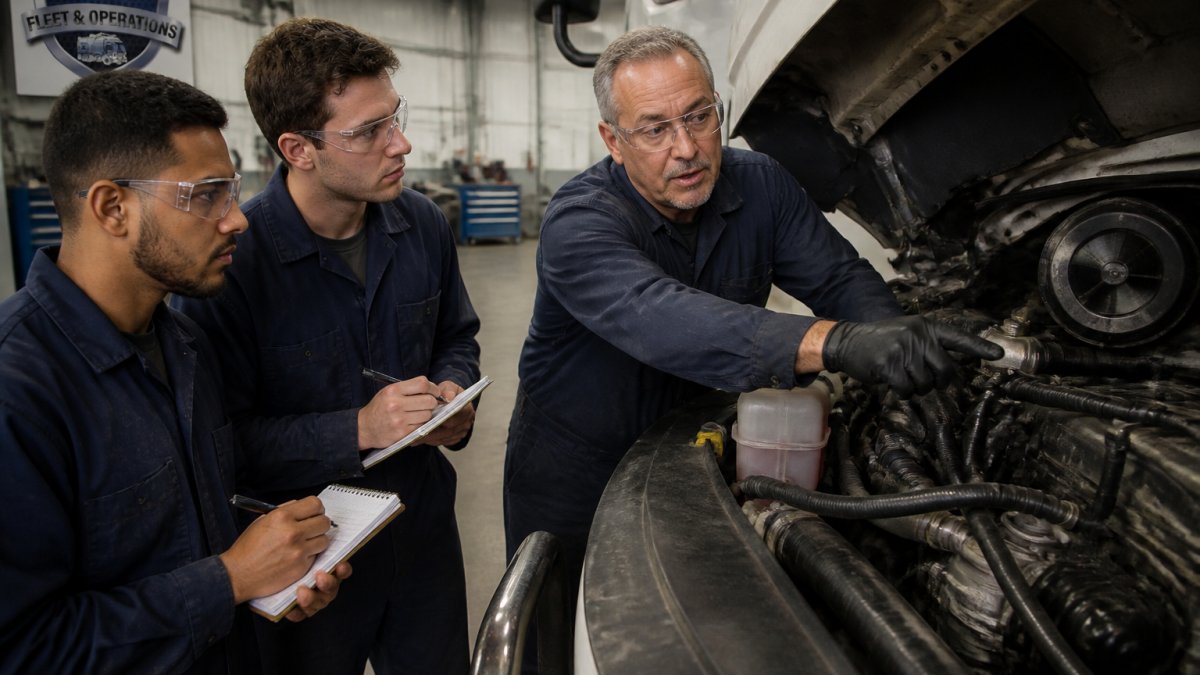
Training is where most programs quietly fail. Technicians attend a session, nod, and return to old habits the following Monday. The fix is not more content. It is training delivered on your trucks, in your bays, with follow-up.
What makes waste fleet maintenance training stick:
- Hands-on practice on the actual equipment your techs service
- Root cause analysis instead of symptom chasing
- A named mentor on the floor after the trainer leaves
- Short refreshers tied to real failures that occurred
Training is led by Master Diesel Technicians with 40 years of industry experience and built around your operation. That matters because a compactor fault on a rear loader is not the same problem as one on a front loader.
Our fuller framework is covered in how to build a waste fleet maintenance training program. The principle is simple: train the behavior, then measure it.
The communication gap deserves attention too. When shop floors and management do not talk, PM delays and repeat failures go unreported. A program that opens that channel fixes problems faster than any single tool.
Program Economics: What the ROI Looks Like in Year One
The honest answer on ROI is that it depends on your baseline. A fleet with heavy breakdown rates has more room to gain than one already running tight. A fixed return cannot be stated without seeing your numbers.
Start with the total cost of the program, not just the software line item. A realistic first-year cost stack includes:
- Telematics or software subscription, per vehicle per month
- Hardware and installation for any added sensors or cameras
- Internal labor for baseline measurement, data validation, and reporting
- Training time, including technician hours off the floor
- Any backfill or overtime created by pulling drivers and techs into sessions
- Program management time, even if it is a current employee wearing a new hat
Most practitioners find the internal labor and training time are the costs that get left out of the business case and then become the reason the program stalls in month four. Put them in the model up front.
On the savings side, build each line from a measured driver rather than a percentage. The four that matter in year one:
- Road calls and emergency repairs: current annual road call volume × average cost per call × a conservative reduction you can defend from your own pilot data.
- Maintenance spend: current annual spend on emergency and unscheduled work, separated from scheduled PM, then apply the shift you expect from earlier fault detection.
- Fuel and idle: current gallons consumed × the idle share you can realistically remove × your average fuel price. Use your own fuel records, not a national average.
- Vehicle utilization: the avoided rental, spare, or overtime cost from covering the same routes with better asset use, or the deferred capital from right-sizing the fleet.
A worked pattern looks like this.
Payback is the metric finance will ask for. Calculate it as total first-year program cost divided by monthly net savings, which gives you months to payback.
Benefits beyond fuel deserve a line in the model even when they are hard to price. Fewer missed pickups reduce credits, re-runs, and complaint handling. Better PM compliance extends component life and defers capital.
Set a review date at 90 days. If the leading indicators, PM compliance and fault resolution time, are moving, the lagging cost numbers will follow. If they are not, the model tells you where to intervene before the year is gone.
To model your own case, our step-by-step ROI calculation guide shows how to build the numbers from your own fleet data. Start with your current road call volume and cost per call, then apply a conservative reduction.
Book Your Complimentary Discovery Call
The gap between a fleet that fights fires and one that runs a program is usually process, not capital. If breakdowns and maintenance costs are eating your margin, the next step is a conversation about your specific operation.
Waste Fleet & Operations works with waste industry operations across a range of fleet sizes. Programs are built around your trucks, with hands-on training on the floor and measurement of progress.
You can review our waste fleet operational audit services to see how an engagement starts, then book a call to talk through your numbers.
Contact Waste Fleet & Operations to discuss how a measured program could improve fleet performance for your operation.
Frequently Asked Questions
What should a waste fleet performance improvement program include?
A working program covers four things: a preventive maintenance schedule built around your routes, KPI tracking for breakdowns, road calls, and idle time, hands-on training for shop technicians, and a review cadence so fixes stick. Software and telematics support it, but they don't replace the process. The test is whether the program changes what happens in the shop bay on a Tuesday morning, not whether it produces a nicer dashboard.
How do you measure waste fleet performance improvement?
Track a small set of numbers before and after: daily breakdowns, road calls per week, unplanned downtime hours, cost per mile, and missed pickups tied to vehicle failure. Set a baseline for 60 to 90 days, then compare. One VP of Operations at a private regional hauler reported reducing daily breakdowns by 25% to sometimes 50%. If you can't show a before-and-after on those five numbers, the program isn't working yet.
We already use fleet management software and a route optimization tool. How is a program different?
Software records what happened. A program changes what your people do next. Telematics will tell you a truck idled for 40 minutes, but it won't tell a technician how to spot the failing component that caused the road call, or how to get the shop floor and dispatch talking about it. Waste fleet management software is a tool inside the program, not a substitute for it. Most haulers already have more data than they act on.
How do you know maintenance training will stick after the consultant leaves?
It sticks when training happens on your trucks, with your technicians, using your actual failure history, and when someone measures the result afterward. Classroom sessions fade in weeks. Hands-on work paired with root cause analysis and a follow-up review keeps the new habits in place. Ask any provider how they measure retention over time.