 How-to
How Should You Build a Waste Fleet Maintenance Training Program?
Last Updated: October 25, 2026
Quick Summary
Waste fleet maintenance training teaches technicians and drivers to inspect, maintain, and diagnose refuse trucks on your actual equipment in your shop. A structured program with four stages, safety, inspection, preventive maintenance, and diagnostics, reduces breakdowns, extends vehicle life, and lowers cost per mile when technicians understand the why behind procedures.
- Build training around your specific trucks, body types, and hydraulic systems, not generic fleet procedures.
- Separate curriculum by role: drivers and helpers inspect and report, technicians diagnose and repair, supervisors reinforce daily.
- Track KPIs before and after training: breakdown rate, road calls, mean time between failures, and maintenance cost per mile.
- Combine digital modules for theory with hands-on shop practice under supervision before technicians work independently.
- Refresh training annually and whenever new equipment joins the fleet, with sign-offs documented for every competency.
Table of Contents
- Why Waste Fleet Maintenance Training Matters to Your Bottom Line
- Building a Waste Truck Maintenance Checklist Into Your Training
- Designing a Fleet Maintenance Training Program for Your Team
- Waste Fleet Technician Training: From Classroom to Shop Floor
- Tracking Fleet Maintenance KPIs to Prove Training Works
- Bridging the Shop-to-Management Communication Gap
- Common Mistakes That Undermine Maintenance Training Success
- Starting Your Waste Fleet Maintenance Training Today
- Frequently Asked Questions
Why Waste Fleet Maintenance Training Matters to Your Bottom Line
High breakdown rates cost you money, routes, customers, and reputation.
The difference between a fleet that breaks down constantly and one that runs reliably comes down to whether your team knows what they're doing.
Waste fleet maintenance training isn't a luxury. It's the foundation of operational efficiency.
The challenge isn't finding training. It's finding training that sticks. Generic maintenance courses don't address the specific demands of waste collection trucks.
Building a Waste Truck Maintenance Checklist Into Your Training
A maintenance checklist is worthless if technicians don't understand why each item matters. The best waste truck maintenance checklist becomes part of your training curriculum, not an afterthought.
Build the checklist around the actual sequence a truck goes through in your shop: pre-trip inspection, post-trip inspection, preventive maintenance interval service, and diagnostic troubleshooting for your most common failure modes.
Pre-Trip and Post-Trip Inspection Items
Drivers and helpers own the pre-trip and post-trip inspection, and training should make clear what they are qualified to check versus what they must report. A workable daily list includes:
- Tires and wheels: tread depth, sidewall damage, lug nut indicators, and air pressure against the placard
- Lights and reflectors: headlights, brake lights, turn signals, backup alarm, and body-mounted work lights
- Fluid leaks under the truck and at the hydraulic reservoir, plus engine oil, coolant, and diesel exhaust fluid levels
Each item should map to a training module. When a helper learns that a weeping hydraulic fitting can become a blown hose and a lost route, they stop walking past it. When a driver understands that a bent packer blade causes uneven packing and premature cylinder wear, they report the damage instead of running the truck until it fails.
Refuse Body, Hydraulic, and Compactor Procedures
This is where waste-fleet training separates from general fleet training. Teach these procedures on your equipment, under supervision, before a technician works independently:
- Hydraulic system: check reservoir level and fluid condition, inspect suction and pressure hoses, torque fittings to spec, and change return filters on the manufacturer's interval. Train technicians to read hydraulic oil color and smell as an early contamination signal.
- Packer and compactor: inspect blade and slide clearances, check for cracked welds at the body seams, verify cylinder pins and bushings, and cycle the packer through a full stroke while watching for drift or hesitation.
- Lift arm and cart tipper: inspect pivot pins, bushings, and hydraulic cylinders; verify the arm returns to stow; and check the safety interlock that prevents operation while the body is raised.
Never train a technician to reach into a packer, hopper, or lift-arm path without lockout/tagout and body props in place. Hydraulic and gravity stored energy is the leading cause of serious injury on refuse equipment, and training should build the lockout habit into every procedure from day one.
Preventive Maintenance Intervals and Diagnostic Modules
Set intervals from the manufacturer's schedule and your duty cycle, then train to them. A common pattern for refuse trucks, which run stop-and-go routes with heavy hydraulic demand:
- Daily: pre-trip and post-trip inspections
- Weekly: fluid checks, hydraulic hose inspection, and body wash-down to spot leaks and cracks
- Monthly: brake inspection and adjustment, tire rotation and pressure audit, and greasing of body, lift, and packer fittings
Pair each interval with a diagnostic module for your most common failure modes: hydraulic hose failures, packer cylinder leaks, brake adjustment drift, electrical faults in body controls, and aftertreatment and diesel particulate filter problems. Technicians should practice the diagnostic sequence, not just read it.
Turning the Checklist Into a Training Tool
The most effective programs build the checklist into hands-on training. Technicians perform each task under supervision, learn what "correct" looks like on your trucks, and repeat until it's automatic. Add a sign-off column so a lead technician or supervisor can verify competency before the technician works alone. Review the checklist quarterly against road-call and repeat-defect data, and update training whenever a new body type, lift configuration, or truck model joins the fleet.
Designing a Fleet Maintenance Training Program for Your Team
A fleet maintenance training program that works is built around your operation, not a template. But it still needs structure: a sequenced curriculum with learning objectives, practice activities, assessments, and a schedule.
Start by mapping your current state: your most common breakdowns, the routes canceled most often, and the maintenance tasks done inconsistently across your shop. Then build the curriculum in four stages, each with a clear objective and a sign-off before the trainee moves on.
Stage 1: Safety and Hazard Recognition
Objective: the trainee can identify the hazards of refuse equipment and work safely around stored hydraulic and gravity energy.
- Practice: lockout/tagout on a packer and lift arm, body prop placement, wheel chock and spotter procedure, and personal protective equipment fit and use
- Assessment: observed demonstration plus a short written check on hazard recognition
- Schedule: before any hands-on work, refreshed annually and after any incident
Stage 2: Inspection and Reporting
Objective: the trainee can complete a pre-trip and post-trip inspection and write a report a technician can act on.
- Practice: supervised inspections on at least three truck configurations in your fleet, with the trainee writing findings in your format
- Assessment: a supervisor audits the trainee's inspection sheets against the truck until the trainee catches the seeded defects
- Schedule: first two weeks for drivers and helpers, then quarterly refreshers
Stage 3: Preventive Maintenance Procedures
Objective: the trainee can perform scheduled service tasks to spec on your equipment.
- Practice: fluid checks and changes, filter replacement, greasing of body and packer fittings, brake adjustment, and hydraulic hose inspection, each performed under supervision until independent
- Assessment: competency sign-off per task, with a re-check at 30 and 90 days
- Schedule: weeks two through eight for new technicians, with annual refreshers on each task
Stage 4: Diagnostics and Repair
Objective: the trainee can diagnose the failure modes your fleet sees most and decide when to repair versus replace.
- Practice: guided troubleshooting on hydraulic, brake, electrical, and aftertreatment faults, using real work orders and a Master Diesel Technician coaching through the sequence
- Assessment: the trainee diagnoses a set of known-fault trucks and explains the reasoning; a lead technician signs off
- Schedule: months two through six, with ongoing case reviews at toolbox talks
Role-Specific Competencies and Who Owns What
Separate the curriculum by role so each person knows what they inspect, report, diagnose, and repair.
- Drivers and helpers: inspect and report. They own the pre-trip and post-trip checklist, fluid and leak observation, body and hopper damage reporting, and clear written descriptions of symptoms. They do not diagnose or repair.
- Technicians: diagnose and repair. They own preventive maintenance procedures, hydraulic and packer diagnostics, brake service, and the repair-versus-replace decision within your authorization limits.
- Lead technicians and Master Diesel Technicians: coach and sign off. They own competency verification, complex diagnostics, and the training of new technicians on the shop floor.
OSHA guidelines on equipment maintenance and worker safety emphasize that training must be documented, role-specific, and tied to actual job tasks. Your program should follow that structure, with a sign-off record for every competency and a schedule that shows when each refresher is due.
Hands-On vs. Digital Training: What Works in Waste Operations
Digital training teaches concepts. Hands-on training teaches judgment. You need both, sequenced so each supports the other.
Use digital modules for safety theory, equipment specs, and procedure review before a trainee touches a truck.
A blended plan that works: assign the digital module one week before the shop session, run the hands-on practice the following week, and schedule a 15-minute refresher at the next monthly toolbox talk. Repeat the cycle annually or whenever equipment changes.
Watch out: digital-only training creates the illusion of learning without building real skill. Technicians pass tests but revert to old habits in the shop because they never practiced the new procedures.
Sample Onboarding and Refresher Schedule
A new technician's first 90 days: week one, safety and hazard recognition; weeks two through four, inspection and reporting plus basic preventive maintenance; weeks five through eight, full preventive maintenance with sign-offs; weeks nine through twelve, guided diagnostics with a lead technician. Drivers and helpers complete safety and inspection in week one, then quarterly refreshers. All roles refresh safety annually, inspection quarterly, and diagnostics annually or when a new truck model or body type enters the fleet.
Book My Complimentary Discovery Call →
A structured waste fleet training program moves technicians through four stages, each with clear objectives and sign-offs before advancement.
| Stage | Objective | Duration | Key Activities |
|---|---|---|---|
| 1: Safety and Hazard Recognition | Identify hazards and work safely around stored energy | Before any hands-on work | Lockout/tagout practice, body prop placement, PPE fit |
| 2: Inspection and Reporting | Complete inspections and write actionable reports | First two weeks | Supervised inspections on three truck configurations |
| 3: Preventive Maintenance Procedures | Perform scheduled service tasks to specification | Weeks two through eight | Fluid changes, filter replacement, greasing, brake adjustment |
| 4: Diagnostics and Repair | Diagnose common failures and decide repair vs. replace | Months two through six | Guided troubleshooting on hydraulic, brake, electrical faults |
Waste Fleet Technician Training: From Classroom to Shop Floor
The transition from training to actual work is where most programs fail.
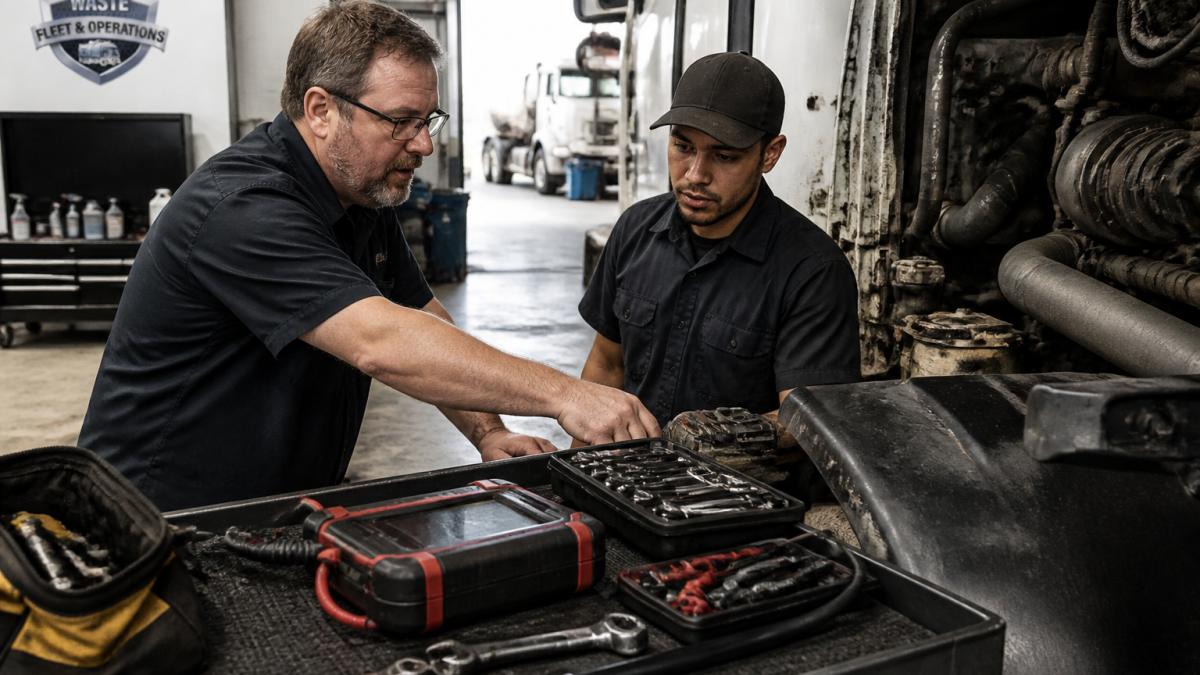
Real learning happens when classroom instruction connects directly to shop floor work.
This is why Waste Fleet & Operations structures training around your actual equipment and workflows.
The shop floor is also where you catch gaps. If a technician struggles during training, you address it before they work independently.
Tracking Fleet Maintenance KPIs to Prove Training Works
You can't improve what you don't measure. Measuring Success in Waste Fleet Training shows how to track the KPIs that prove training is changing behavior and reducing costs. Fleet maintenance KPIs show whether training is actually changing behavior and reducing costs.
The most important KPIs to track:
- Daily breakdown rate: How many trucks are out of service each day due to maintenance issues
- Road calls: How many trucks break down while on a route and need roadside assistance
- Mean time between failures: How long a truck runs between major repairs
Track these metrics before training starts, then again at 30 days, 90 days, and 6 months. You should see movement in multiple metrics: breakdown rates drop, road calls decrease, and preventive maintenance completion improves.
EPA guidelines on fleet maintenance and emissions compliance include documentation requirements that align with tracking these KPIs. Your measurement system should capture data that satisfies both operational needs and regulatory requirements.
The metrics also reveal which training worked. If road calls drop but preventive maintenance completion doesn't improve, training may have focused on the wrong skills.
Bridging the Shop-to-Management Communication Gap
Maintenance problems management doesn't know about don't get fixed. Shop Floor Communication in Waste Fleets: A How-To Guide covers strategies for ensuring technicians and managers stay aligned on vehicle issues and priorities.
The gap happens because technicians and managers speak different languages. A technician says "the transmission is slipping." Management hears "we need a new transmission" and thinks capital expense.
Effective waste fleet maintenance training includes communication protocols. Technicians learn to describe problems in terms managers understand: cost impact, safety risk, and timeline to failure.
Documentation supports this.
Common Mistakes That Undermine Maintenance Training Success
Most waste fleet maintenance training fails for the same reasons. Why Waste Fleet Training Fails (And How to Fix It) addresses each pitfall and how to avoid it.
Mistake 1: Training without follow-up. A consultant delivers training and leaves.
Mistake 3: Training only the technicians. If supervisors and managers don't understand the training, they can't support it.
Mistake 4: No measurement of results. Training happens, but nobody tracks whether it changed anything.
Mistake 5: Treating training as a one-time event. Equipment changes, new technicians join, and procedures improve.
Starting Your Waste Fleet Maintenance Training Today
The first step isn't hiring a consultant. It's getting clarity on where you stand.
Map your current maintenance costs. Calculate your breakdown rate. Document your most common repairs.
Then define your role-specific competencies. What should a lead technician be able to do that they can't do now?
Build your training program around these competencies, delivered on your equipment, in your shop, with your team.
Frequently Asked Questions
What should waste fleet maintenance training cover?
Effective waste fleet maintenance training covers preventive maintenance protocols specific to waste trucks, vehicle inspection procedures, hazard recognition, DOT compliance requirements, OSHA safety standards, and proper use of personal protective equipment. It should also include hands-on diagnostics, root-cause analysis of common breakdowns, and shop management practices. The training must address the unique demands of solid waste operations, including the impact of heavy loads, frequent stops, and harsh operating conditions on fleet equipment and vehicle standards.
How often should waste fleet technician training occur?
Initial waste fleet technician training should be comprehensive and hands-on, typically spanning multiple days or weeks depending on role and experience level. After that, refresher training every 6-12 months keeps skills current and reinforces best practices. Safety training and regulatory compliance updates should occur annually or whenever DOT or OSHA regulations change. Ongoing training completion tracking ensures accountability and identifies skill gaps before they cause vehicle downtime or safety incidents.
What metrics show whether fleet maintenance training is working?
Key fleet maintenance KPIs include daily breakdown rates, road call frequency, vehicle downtime hours, maintenance costs per truck per month, preventive maintenance completion rates, and technician certification status. Track incident prevention outcomes and compare pre- and post-training data. Measure training completion rates and competency assessments. Monitor whether technicians apply learned skills consistently and whether communication between shop and management improves.
Can maintenance training work for smaller waste operations?
Yes. Waste fleet maintenance training scales to operations of any size, from 15-20 trucks to large fleets. Smaller operations often see faster results because technicians and management communicate more directly. Training can be customized to your specific equipment, routes, and operational challenges. The key is ensuring all maintenance staff and helpers receive role-specific competencies and that training addresses your actual waste truck maintenance procedures and equipment, not generic fleet guidance.
Waste Fleet & Operations helps waste haulers build training programs that reduce breakdowns and lower maintenance costs. Our Master Diesel Technicians work with your team on your trucks to develop competencies that stick. The result: fewer road calls, better preventive maintenance compliance, and measurable ROI within 90 days. Book My Complimentary Discovery Call to discuss how a structured waste fleet maintenance training program fits your operation.