 Ultimate guide
Waste Hauling Fleet Leadership Development: The Complete Guide
Table of Contents
- Why Fleet Leadership Decides Whether Your Waste Operation Runs or Breaks
- The Core Competencies Every Waste Fleet Leader Needs
- How to Build a Fleet Leadership Development Plan That Sticks
- Fleet Manager Training: What Actually Works on the Yard
- Waste Fleet Performance Metrics That Reveal Leadership Gaps
- Fleet Training Evaluation: Proving the Program Paid Off
- Coaching, Feedback, and Succession Planning on the Route
- Change Management for Fleet Technology Adoption
- Frequently Asked Questions
Last Updated: October 17, 2026
Why Fleet Leadership Decides Whether Your Waste Operation Runs or Breaks
Waste hauling fleet leadership development is the discipline of building supervisors, shop leads, and route managers who can hold safety, maintenance, and productivity together on the same shift.
That distinction matters more than most operators admit. A rear-loader with a leaking hydraulic line is a maintenance problem for about an hour.
The gap is rarely technical. Master Diesel Technicians can diagnose a failing brake chamber in minutes.
Below, we break down the competencies, the roadmap, and the measurement systems that separate haulers who develop fleet leaders from those who keep hiring replacements.
The Core Competencies Every Waste Fleet Leader Needs
Fleet leadership in waste hauling rests on four competencies: maintenance planning, safety enforcement, people development, and operational judgment under pressure. Miss any one and the others degrade.
The waste and recycling industry adds a wrinkle most leadership frameworks ignore. Your frontline workforce is dispersed across routes for ten hours a day, often alone, often in weather. You cannot supervise by walking the floor.
That is why generic leadership training borrowed from manufacturing falls flat on a hauling yard. The context is different: equipment is mobile, downtime is public, and a missed route is visible to every customer on the street.
From Shop Floor to Management: Role-Specific Skill Sets
Competencies should shift as people move up. A technician promoted to shop lead needs different training than a shop lead moving into fleet management. Treating those as the same transition is a common mistake, and it is why so many strong wrenches struggle as supervisors.
| Role | Core Competency Focus | Training Priority |
|---|---|---|
| Shop technician | Diagnostics, documentation, preventive maintenance discipline | Hands-on technical training, root cause analysis |
| Shop lead | Work order prioritization, coaching, vendor coordination | Feedback skills, scheduling, fleet maintenance planning |
| Route supervisor | Driver coaching, incident response, daily route operations | Safety leadership, communication, conflict resolution |
| Fleet manager | Budget ownership, vehicle availability, performance metrics | Strategic planning, data literacy, change management |
The progression is not automatic. A technician who documents every repair meticulously may still freeze when a driver pushes back on a safety write-up.
How to Build a Fleet Leadership Development Plan That Sticks
A fleet leadership development plan works when it ties every training hour to a measurable operating outcome, runs in cohorts rather than one-off sessions, and gives participants real problems to solve on their own yard.
Most failed programs share a root cause: they are events, not systems. A consultant delivers two days of content, everyone nods, and within six weeks the shop reverts to the old way of doing things.
Start by defining what a competent fleet leader looks like in your operation. Not in the abstract, but in behaviors you can observe.
A 12-Month Roadmap for Small and Mid-Sized Haulers
Small operators with 15 to 20 trucks often assume structured development is out of reach. It is not, but the plan has to fit the scale. Here is the sequence we would run.
- Months 1-2: Assess and baseline. Interview every supervisor, review 12 months of road calls and breakdowns, and identify which failures trace back to a decision nobody made. Document current vehicle availability and preventive maintenance compliance.
- Months 3-4: Define competencies and pick a cohort. Write role-specific expectations for shop leads and route supervisors. Select six to ten people for the first cohort rather than training everyone at once.
- Months 5-8: Run the core program. Combine hands-on yard sessions with monthly coaching conversations. Assign each participant a live improvement project tied to fleet performance.
- Months 9-10: Add technology and data literacy. Train leaders on the fleet management software and telematics reports they are expected to act on. This is where most programs stall, so budget extra time.
- Months 11-12: Evaluate and plan the next cohort. Compare baseline metrics to current numbers, document what changed, and promote the strongest participants into expanded responsibilities.
Fleet Manager Training: What Actually Works on the Yard
Fleet manager training that changes behavior happens on the yard, with your trucks, using your actual failure history.
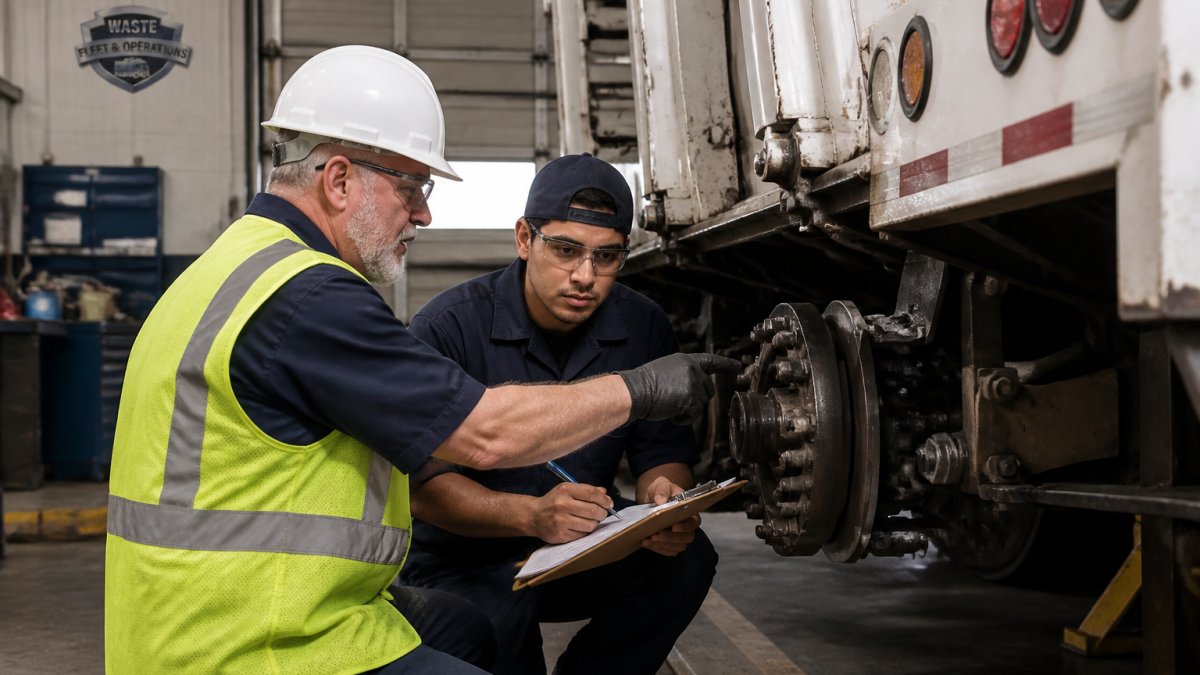
The most effective format we have seen pairs a hands-on technical block with a leadership block in the same day. Morning: root cause analysis on a real defect found that week.
Cohort-based learning outperforms self-paced video for one reason: peers hold each other accountable.
What most guides miss is the follow-up cadence. Training videos and in-person sessions are the easy part.
Waste Fleet Performance Metrics That Reveal Leadership Gaps
Waste fleet performance metrics are only useful if they point to a person and a decision. Road calls per 1,000 miles, vehicle availability, preventive maintenance compliance, and repeat-defect rate all trace back to leadership behavior, not just equipment condition.
Consider vehicle availability.
Book My Complimentary Discovery Call →
Repeat defects are the most revealing number and the least tracked. When the same component fails on the same unit three times in a quarter, you either have a diagnostic problem or a process problem.
| Metric | What It Signals | Leadership Behavior to Check |
|---|---|---|
| Road calls per 1,000 miles | Preventive maintenance discipline | Does the shop lead have authority to pull units? |
| Vehicle availability | Maintenance planning quality | Is scheduling proactive or reactive? |
| PM compliance rate | Follow-through on process | Are supervisors inspecting completed work? |
| Repeat defect rate | Diagnostic and documentation quality | Is root cause analysis actually happening? |
| Driver-reported defects | Frontline engagement | Do drivers believe reports get acted on? |
Fleet Training Evaluation: Proving the Program Paid Off
Fleet training evaluation answers one question: did behavior change, and did the change move an operating number? Reaction surveys and attendance records do not answer it. Baseline-versus-current comparisons on specific metrics do.
Build the evaluation before the training starts. Capture 90 days of road calls, breakdown frequency, PM compliance, and maintenance spend per unit. Then compare the same metrics over the same window after the program.
Measure at three levels. First, did participants learn the content, checked through practical assessments on real equipment. Second, did they apply it, verified through supervisor observation and work order quality.
Coaching, Feedback, and Succession Planning on the Route
Coaching and succession planning are the two elements most haulers skip, and they are the two that determine whether leadership development survives a single retirement.
Route supervisors face a coaching problem most industries never encounter. Their people are alone in a truck for most of the day.
We recommend a simple four-part conversation for every ride-along: what went well, what nearly went wrong, what the driver would do differently, and what the supervisor will follow up on.
Succession planning starts with a simple, uncomfortable exercise. For each critical role, write down who covers it if the person leaves next month.
Change Management for Fleet Technology Adoption
Change management is the difference between a fleet management software rollout that improves operations and one that generates six months of complaints.
The most common failure is launching technology as a monitoring tool rather than a coaching tool. Drivers and technicians who believe a system exists to catch them will game it, ignore it, or leave.
- Name an owner for each system. A tool with no owner becomes a dashboard nobody opens.
- Train supervisors first, operators second. Supervisors must be able to answer "what do I do with this alert" before drivers are asked to trust it.
- Connect every alert to a workflow. A telematics fault code with no assigned work order process is noise.
- Publish early wins. When video intelligence prevents an incident or predictive maintenance catches a failing component, tell the whole team.
- Expect a dip. Productivity and trust often sag in the first quarter. Plan for it rather than abandoning the rollout.
This is where experienced outside support earns its place. At Waste Fleet & Operations, our work with haulers centers on hands-on training with your own trucks and root cause analysis tied to your actual failure history, so technology adoption lands on a workforce that already knows how to act on what the data shows.
Every hauler eventually faces the same inflection point: the equipment gets newer, the software gets smarter, and the results stay flat because nobody developed the people in between. Building fleet leadership is slower than buying a platform and far more durable.
Frequently Asked Questions
What skills does a waste fleet leader need?
The strongest waste fleet leaders combine four skill sets. First, technical credibility: they understand preventive maintenance, hydraulic systems, and what a failing packer sounds like. Second, people leadership: coaching drivers and technicians, giving feedback, and holding accountability conversations. Third, operational discipline: maintenance planning, parts inventory, and route coordination. Fourth, financial literacy: reading cost-per-mile, labor hours, and downtime data well enough to defend a budget. Most promotions fail because the technical skill is strong but the coaching and financial skills were never taught.
How do you develop leadership skills in fleet managers?
Start with a fleet leadership development plan built around your own operation. Pair each manager with a mentor who has run waste hauling routes, then add cohort-based learning so peers solve real problems together. Keep classroom time short and put most hours on the yard with actual trucks. Assign a stretch project, such as rebuilding a preventive maintenance schedule for one division, and review progress monthly. Leadership skills grow through repeated practice with feedback, not through a single seminar.
How can waste haulers measure the success of fleet training?
Measure before and after. Track waste fleet performance metrics such as daily breakdowns, road calls per 100 trucks, preventive maintenance completion rate, vehicle availability, maintenance cost per mile, and repeat repairs on the same unit. A well-run fleet training evaluation also captures leading indicators: technician retention, safety observations, and how quickly new hires reach full productivity. One regional hauler reported cutting daily breakdowns by 25% to sometimes 50% after structured training. Set baselines first, then review quarterly.
What should a waste fleet leadership development program include?
A complete program covers four parts. Role-specific competencies for supervisors, maintenance leads, and operations managers. Hands-on technical training on your own equipment, not generic classroom content. Coaching and feedback practice, including how to run a shift handoff and a root cause review. And a measurement layer that ties training hours to fleet performance, safety outcomes, and cost reduction. Small operators with 15 to 20 trucks need the same four parts, just delivered in shorter sessions.
How often should fleet leaders receive training?
Plan for a continuous cycle rather than an annual event. Run a formal cohort session each quarter, hold short weekly toolbox talks on safety and maintenance topics, and schedule monthly one-on-one coaching between supervisors and their leads. Refresher training on high-risk tasks, such as working under raised beds or handling hydraulic lines, should happen at least twice a year. New supervisors benefit from a structured 90-day onboarding with weekly check-ins.
How can supervisors improve driver safety and accountability?
Use data from telematics and video intelligence to make coaching specific instead of personal. Review harsh braking, speeding, and backing incidents weekly with each driver, and pair the conversation with a clear standard for what good looks like. Recognize improvement publicly. Accountability works when expectations are documented, feedback is timely, and consequences are consistent. Supervisors who ride along once a quarter spot more issues than any dashboard and build the trust that makes hard conversations possible.
What is the difference between fleet leadership training and fleet management training?
Fleet management training teaches the mechanics of the job: maintenance planning, software use, compliance paperwork, and budget tracking. Fleet leadership training develops the ability to influence people: coaching technicians, managing change, building succession plans, and connecting shop-floor decisions to business outcomes. Most waste haulers invest in management training and skip leadership development, then wonder why communication between the shop and the office breaks down. The best programs combine both.