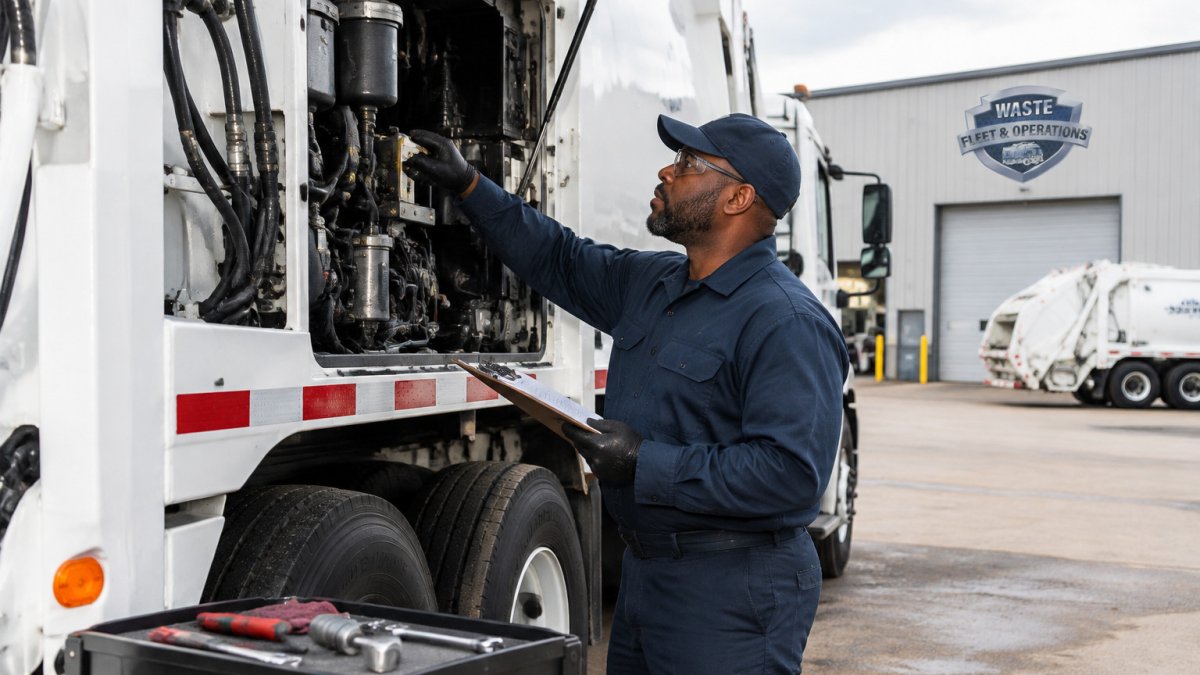
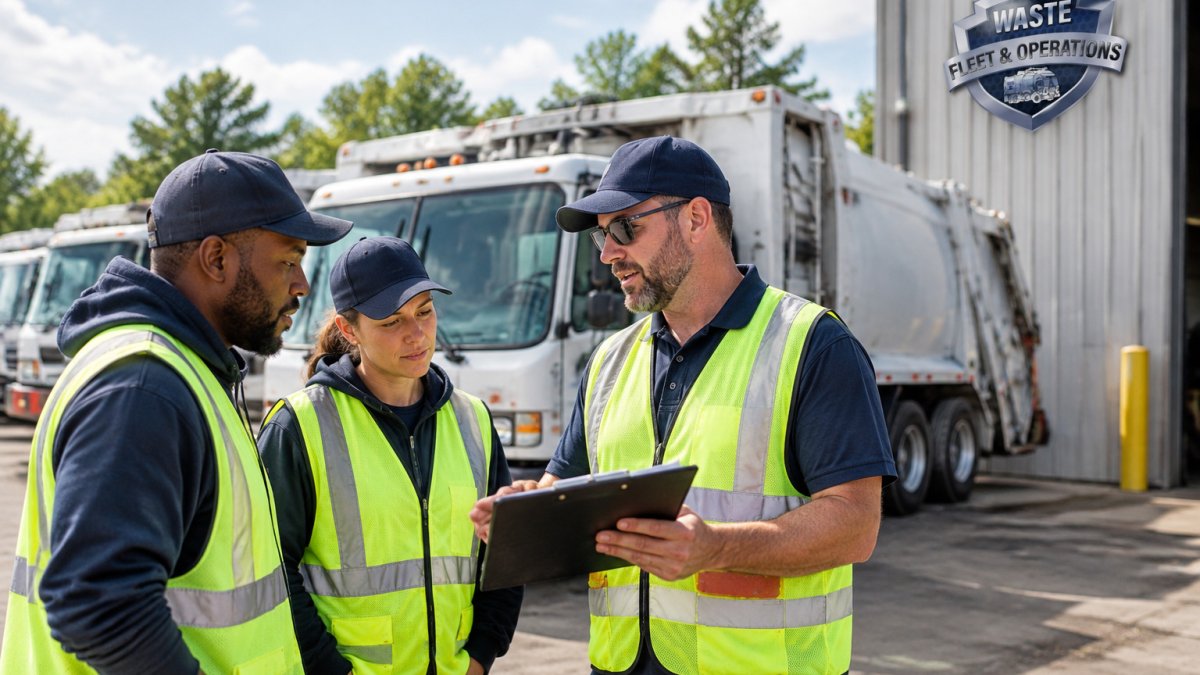
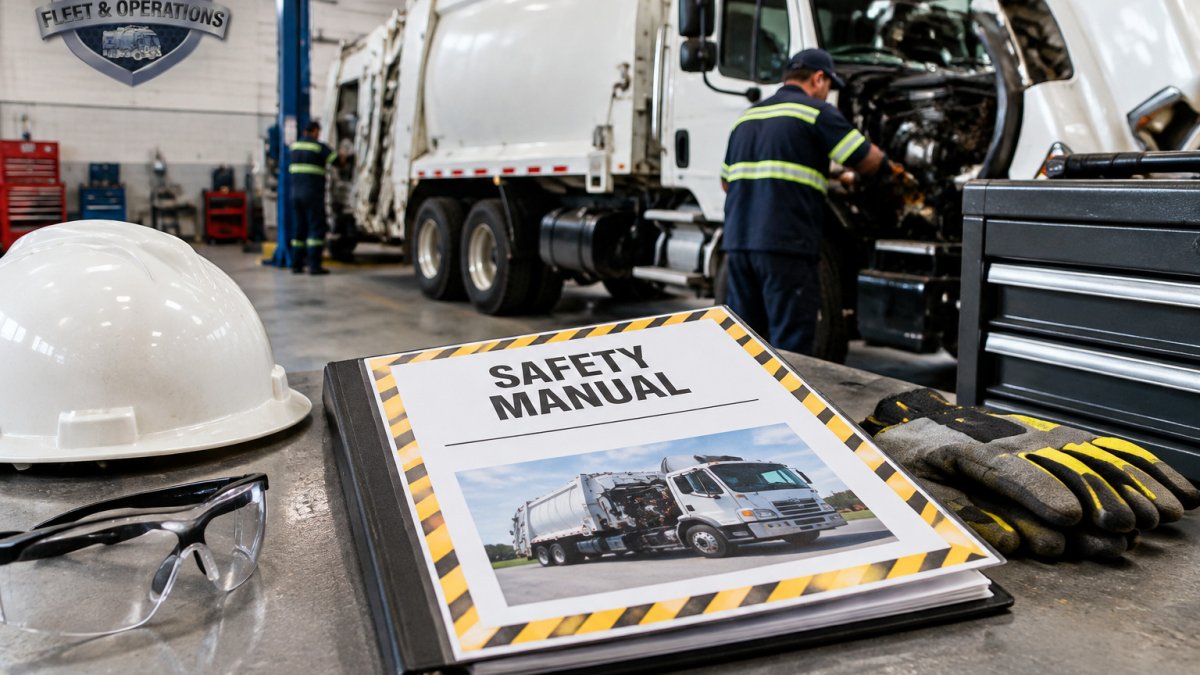
 Ultimate guide
What Is a Waste Fleet Shop Safety Manual? A Guide
Last Updated: November 14, 2026
Quick Summary
A waste fleet shop safety manual is a written document setting out the rules, procedures, and responsibilities that govern work inside a maintenance shop servicing refuse and recycling vehicles. It covers hazard identification, access controls, personal protective equipment, lockout/tagout steps, inspection routines, and incident reporting, giving every technician and supervisor the same reference point for waste fleet shop safety.
- Refuse-specific hazards most manuals miss include compactor blade exposure, contaminated components, and stored hydraulic energy.
- Your manual should define written procedures for the ten core tasks your shop performs most often.
- Energy isolation must address electrical, hydraulic, pneumatic, and gravity sources, never a hydraulic cylinder alone.
- Daily checks cover housekeeping, machine guarding, spill kits, lockout tags, and extinguisher access.
- Write procedures with the technicians who do the work, and review the manual at least annually.
Table of Contents
- What a Waste Fleet Shop Safety Manual Is and Why It Matters
- Waste-Collection Shop Hazards Most Manuals Miss
- Essential Fleet Maintenance Safety Procedures
- Lockout/Tagout and Energy Isolation for Refuse Equipment
- Building Your Shop Safety Manual Template
- The Fleet Shop Safety Checklist for Daily and Weekly Inspections
- Fleet Maintenance Safety Training That Sticks
- Book a Complimentary Discovery Call to Review Your Shop Safety Program
- Frequently Asked Questions
What a Waste Fleet Shop Safety Manual Is and Why It Matters
A waste fleet shop safety manual is a written document that sets out the rules, procedures, and responsibilities that govern work inside a maintenance shop servicing refuse and recycling vehicles.
Why it matters is simple: a waste shop is not a general repair bay. Technicians work around compacting bodies, hydraulic systems under load, and vehicles that arrive coated in whatever the route collected.
A manual is the operating agreement between the shop floor and management.
Waste-Collection Shop Hazards Most Manuals Miss
Generic shop safety templates were not written for refuse equipment, and the gaps show up fast.
Here is what we see missed most often:
- Compactor and packer blade exposure. Technicians near a partially cycled packer face stored hydraulic pressure and moving blades a standard lockout procedure may not fully address.
- Contaminated components. Brake drums, hydraulic lines, and undercarriage parts arrive coated in leachate and waste residue, changing how you handle them and what protective clothing is needed.
- Stored energy in hydraulic systems. Refuse bodies rely on large hydraulic circuits; pressure can remain after shutdown, and energy isolation must account for accumulators and gravity-loaded components.
Watch out: the most common mistake is copying a manual from a different industry and changing the logo. If your procedures do not name refuse-specific equipment, your technicians will treat the whole document as irrelevant.
Essential Fleet Maintenance Safety Procedures
At minimum, your manual should define written procedures for the tasks your shop performs most, with each one naming the hazard, the controls, and who is responsible. The core set looks like this:
- Hazard identification and risk assessment before any non-routine job begins
- Access controls limiting the shop floor to authorized, trained personnel
- Personal protective equipment requirements by task, including protective clothing for contaminated work
- Machine guarding checks on shop equipment and tools
- Chemical handling with safety data sheets on file and spill response steps posted
- Lifting techniques and material handling rules for heavy components
- Housekeeping standards covering slip, trip, and fall prevention
- Fire prevention and emergency response with evacuation routes and extinguisher locations
- Incident reporting with a clear chain from technician to supervisor
- Vehicle maintenance and equipment inspection tied to service schedules
Engineering controls come first where feasible, administrative controls and safe work practices follow, and PPE is the last layer rather than the only one (the CDC).
What separates a waste fleet manual from a generic one is the exposure-control layer most templates omit. Refuse trucks arrive carrying what the route collected, and the shop inherits that load. Build these procedures in as named sections rather than assuming technicians will figure them out:
- Bloodborne pathogens and sharps. Write an exposure control plan identifying job classifications with occupational exposure, listing tasks where sharps or contaminated materials may be encountered, and specifying PPE, handwashing, and disinfection steps. State where the exposure control plan lives and who reviews it.
- Contaminated component handling. Define a decontamination step before teardown, specify gloves and protective clothing rated for the task, and name where wash water goes so it does not become a floor hazard or an unpermitted discharge.
- Dust, exhaust, and noise. Specify local exhaust or dilution ventilation for welding and grinding, keep diesel engines from idling in enclosed bays, and set a hearing conservation program with noise monitoring and hearing protection where levels warrant it.
Each procedure should follow the same structure: the task, the hazards, the engineering and administrative controls, the required PPE, the step-by-step method, and the person accountable for enforcement.
Watch out: the most common failure is a manual that lists exposure controls in a policy paragraph but never translates them into task-level steps.
Lockout/Tagout and Energy Isolation for Refuse Equipment
Lockout/tagout is the procedure for shutting down equipment, isolating every energy source, and locking it out so it cannot restart while someone is working on it. For refuse equipment, that means more than flipping a switch.
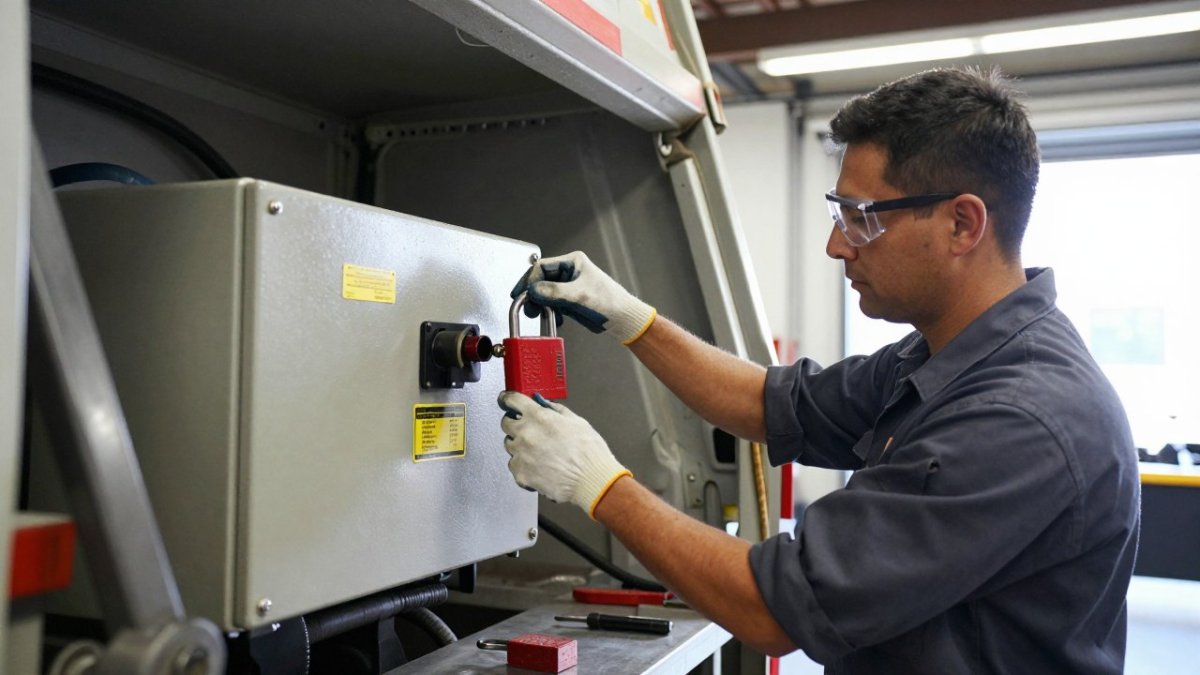
Your energy isolation procedure should address each source individually:
- Electrical: battery disconnect, master switches, and any auxiliary circuits
- Hydraulic: pump shutdown, valve isolation, and controlled release of stored pressure
- Pneumatic: air system bleed-down where applicable
Each lock should carry a named tag, and only the technician who applied it should remove it. Group lockout procedures matter when two people work the same truck.
Building Your Shop Safety Manual Template
A usable manual follows a predictable structure. Start with these sections and adapt the content to your operation:
| Section | What It Contains | Who Owns It |
|---|---|---|
| Purpose and scope | Why the manual exists, which shop and roles it covers | Operations manager |
| Roles and responsibilities | Named accountability for supervisors, leads, technicians | Shop supervisor |
| Access controls | Authorized personnel rules, visitor and vendor policy | Shop supervisor |
| Hazard identification | Shop-specific hazard list and risk assessment method | Safety lead |
| Safe work practices | Step-by-step procedures by task | Shop lead technicians |
| PPE requirements | Task-by-task protective equipment matrix | Safety lead |
| Lockout/tagout | Energy isolation steps per equipment type | Maintenance director |
| Emergency response | Evacuation, spill response, first aid, contacts | Safety lead |
| Incident reporting | Reporting chain, forms, investigation steps | Operations manager |
| Training records | Who is trained on what, with dates and sign-offs | Shop supervisor |
A table of contents is not a manual. What most operations lack is the language and forms that turn the outline into a usable document. Build the template around four working parts:
1. Policy language you can adapt. Each section should open with a short policy statement naming the standard and the employer's commitment. For example: "Only authorized, trained employees may enter the shop floor. Visitors and vendors must be escorted and must wear the PPE required for the area they enter. The shop supervisor maintains the authorized-access list and reviews it quarterly." A lockout/tagout policy states that no employee may perform maintenance until every energy source is isolated, locked, tagged, and verified, and that only the employee who applied a lock may remove it. Keep the policy to a paragraph in plain language, with procedure steps underneath.
**2.
**3.
4. Revision and review mechanics. Name who owns the manual, how often it is reviewed (at least annually and after any serious incident or equipment change), and how changes are communicated.
Two rules make the difference between a manual that gets used and one that collects dust. First, write procedures with the technicians who do the work, not for them. Second, keep the revision log current when equipment or staffing changes. If shop-floor communication is already weak, our guide to shop floor communication in waste fleets covers how to make sure the new procedures actually reach the crew.
Once the manual is written, implementation determines whether it survives. Set an inspection schedule matching the manual's checklists, daily walk-throughs, weekly audits, monthly reviews of incident and near-miss reports, and assign each to a named role.
Watch out: the most common mistake is adopting a template wholesale and changing only the logo.
The Fleet Shop Safety Checklist for Daily and Weekly Inspections
A checklist turns the manual into a routine. Daily checks catch what changes shift to shift; weekly checks catch what drifts over time.
Daily, before the shift starts:
- Walk the shop floor for housekeeping and slip, trip, and fall hazards
- Confirm machine guarding is in place on shop equipment
- Check that spill kits and safety data sheets are stocked and accessible
Weekly:
- Review incident and near-miss reports with the crew
- Inspect lifting equipment and shop tools
- Audit PPE condition and restock
Tie these checks to your service schedule so inspections feed directly into planned maintenance rather than sitting in a separate binder. Our article on preventive maintenance strategies for sanitation trucks shows how to connect inspection findings to scheduled work.
Fleet Maintenance Safety Training That Sticks
Most safety training fails for one reason: it happens once, in a classroom, and never touches the shop floor again. Technicians revert to old habits the moment the trainer leaves, and supervisors have no way to measure whether anything changed.
Training that sticks happens at the truck, on real equipment, with the technicians who will perform the task. It is reinforced by short, repeated toolbox talks rather than a single annual session, and it is measured, with supervisors observing procedures in practice and recording what they see.
Training is built around your operation rather than a template, delivered hands-on with your trucks by Master Diesel Technicians with 40 years of industry experience. If your past training has not held, our breakdown of why waste fleet training fails and how to fix it explains the usual causes. For a deeper look at structuring the program itself, see how to build a waste fleet maintenance training program, and for shop staff specifically, our guide to training shop technicians for waste fleets covers role-by-role requirements.
Book a Complimentary Discovery Call to Review Your Shop Safety Program
The hardest part of a safety manual is not writing it.
That is where we come in. Waste Fleet & Operations provides consulting and training built around your operation, not a template.
Bring your current manual, your incident reports, and your open questions.
If your safety program exists mostly on paper, the next step is a conversation about what it would take to make it operational.
Frequently Asked Questions
Does OSHA require a safety manual?
OSHA does not name a document called a 'safety manual' in its standards, but several rules require written programs. Hazard communication, lockout/tagout, and emergency action plans all call for written procedures, and OSHA's general duty clause expects employers to address recognized hazards. A waste fleet shop safety manual is the practical way to put those written requirements in one place that technicians and managers can actually use.
What should a fleet shop safety manual include?
A complete manual covers hazard identification, access controls, personal protective equipment, safe work practices, machine guarding, tool and equipment inspection, lockout/tagout, chemical handling with safety data sheets, spill response, housekeeping, fire prevention, emergency response, and incident reporting. For waste fleets, add refuse-vehicle hazards: hydraulic systems, compactors, and exposure controls for the residue technicians handle. Include employee responsibilities and training records so accountability is clear.
How often should a shop safety manual be reviewed?
Review the manual at least once a year and after any serious incident, new equipment purchase, or change in procedures. Waste fleet operations change quickly: new truck bodies, different hydraulic systems, and added routes all introduce hazards the old version may not address. A yearly review with technicians in the room catches gaps before an inspector or an injury does.
Who is responsible for training employees on shop safety procedures?
The employer is responsible, and that responsibility usually lands on the shop supervisor or maintenance director. Hands-on training works better than classroom sessions for fleet maintenance safety training because technicians learn lockout/tagout, lifting techniques, and equipment inspection on the trucks they actually service. Document every session with names, dates, and topics covered so training records hold up during an OSHA inspection.
How can a waste fleet maintenance shop reduce workplace hazards?
Start with hazard identification: walk the shop and list what can injure someone, from slips and falls to stored hydraulic energy. Then apply controls in order: engineering controls like machine guarding first, administrative controls like procedures and schedules second, and personal protective equipment last. A fleet shop safety checklist used daily catches housekeeping and equipment problems before they become incidents, and regular audits measure whether the program is working.
Can a small operation with 15 to 20 trucks use a full safety manual?
Yes, and smaller fleets often benefit most because one injury or OSHA citation hits harder. Scale the manual to your shop: fewer pages, but the same core sections on hazard identification, lockout/tagout, PPE, and emergency response. A shop safety manual template built for waste fleets saves the weeks it would take to write one from scratch, and it can grow as you add trucks and routes.