 blog
How to Build a Preventive Maintenance Program in 7 Elements
Last Updated: November 17, 2026
Quick Summary
The 7 elements of preventive maintenance are asset inventory and criticality ranking, inspection and routine checks, testing, servicing and calibration, a workable maintenance schedule, documented examples from your own fleet, a checklist techs actually use, and best practices you measure. The elements are the system that makes sure tasks happen on time, on the right truck, and with a record you can trust.
- An element is a building block of your program; an activity is a single job performed on a single unit.
- Rank assets A-B-C by criticality so time and budget go to front-line units first.
- Match calendar, meter, or condition triggers to each task's failure mode.
- Build one checklist per asset type, grouped by system, with pass/fail fields.
- Track five KPIs: PM compliance, planned vs. unplanned work, backlog age, downtime, and repeat failures.
Table of Contents
- What Are the 7 Elements of Preventive Maintenance?
- 1. Asset Inventory and Criticality Ranking
- 2. Inspection and Routine Checks
- 3. Testing, Servicing, and Calibration
- 4. Building a Preventive Maintenance Schedule That Holds
- 5. Preventive Maintenance Examples From Waste Fleet Operations
- 6. The Preventive Maintenance Checklist Your Shop Actually Uses
- 7. Preventive Maintenance Best Practices and How to Measure Them
- Frequently Asked Questions
What Are the 7 Elements of Preventive Maintenance?
Preventive maintenance is the planned work a shop performs on equipment before it fails, and it rests on seven elements: asset inventory and criticality ranking, inspection and routine checks, testing, servicing and calibration, a workable maintenance schedule, documented examples from your own fleet, a checklist techs actually use, and best practices you measure. This guide breaks down each one.
Here is the part most guides get wrong. They mix up the seven activities with the seven elements of a program. The activities are the tasks. The elements are the system that makes sure the tasks happen on time, on the right truck, and with a record you can trust.
Below, we'll show you exactly how to build that system, section by section, with the order we would use.
Elements vs. Activities: Clearing Up the Confusion
An element is a building block of your program. An activity is a single job performed on a single unit.
Why does the distinction matter? Because most failed programs have plenty of activities and almost no structure.
If you want to see how this split plays out across the full range of maintenance types, our breakdown of the 5 types of preventive maintenance shows the distinction in practice.
OSHA's vehicle maintenance guidance for general industry treats maintenance as a documented, scheduled duty rather than an ad hoc repair habit, which is the same principle.
The seven elements of a preventive maintenance program, in the order the guide builds them.
| Element | What it covers |
|---|---|
| 1. Asset inventory and criticality ranking | Complete asset registry, then rank assets A-B-C by criticality |
| 2. Inspection and routine checks | Daily and weekly eyes-on work: walkarounds, fluid, tire, brake, light checks |
| 3. Testing, servicing, and calibration | Verify performance, replace wear items on interval, keep tools accurate |
| 4. A workable maintenance schedule | Calendar plus trigger rules: calendar, meter, and condition triggers |
| 5. Documented examples from your own fleet | Brake inspection, hydraulic servicing, tire rotation and pressure checks |
| 6. A checklist techs actually use | One-page, unit-specific task list a tech can complete and sign |
| 7. Best practices you measure | Five KPIs: PM compliance, planned vs. unplanned, backlog age, downtime, repeat failures |
1. Asset Inventory and Criticality Ranking
The first element is a complete asset registry. Every truck, trailer, loader, and piece of shop equipment gets a record: unit number, make, model, year, mileage or hours, and service history.
Then rank each asset by criticality. A common approach is a simple A-B-C system:
- A assets: front-line collection trucks. A failure stops a route.
- B assets: spares and support units. A failure costs money but not service.
- C assets: shop equipment and low-use units.
Criticality drives where your time and budget go first.
2. Inspection and Routine Checks
Inspection is the daily and weekly eyes-on work: walkarounds, fluid checks, tire and brake look-overs, and light checks. Routine checks catch small problems while they are still cheap.
Two habits make this element work. First, give drivers a short, standard pre-trip form so every check looks the same. Second, have techs log what they find, even when they find nothing.
What most guides miss is the value of the "nothing found" entry.
3. Testing, Servicing, and Calibration
Testing verifies that a system performs as designed. Servicing replaces wear items on a set interval. Calibration keeps measurement tools accurate, including torque wrenches, gauges, and diagnostic equipment.
Skip calibration and your "tested" results mean little.
Use standardized procedures for each task. A written procedure means two techs service the same component the same way, which makes results comparable over time.
4. Building a Preventive Maintenance Schedule That Holds
A maintenance schedule is a calendar plus trigger rules. It states which service happens at which interval, what event starts the clock, and who owns the outcome.
How to Choose Maintenance Intervals
Intervals come from four inputs, and you should weigh all four rather than defaulting to one:
- Manufacturer guidance sets the baseline interval for each service task. Treat it as the floor, not the ceiling.
- Operating conditions adjust the baseline. Stop-and-go collection routes, heavy loads, dust, and temperature swings shorten the useful life of fluids, filters, and brake components.
- Failure history tells you where the baseline is wrong. Pull the last 12 months of work orders and look for repeat failures on the same component and unit. A component that fails twice inside the book interval is telling you the interval is too long for your duty cycle.
A practical way to set a first interval: start at the manufacturer's number, shorten it by one step for A assets on severe duty, and lengthen it only after two clean inspection cycles with no findings. Document the reasoning next to the interval so the next person understands why it is what it is.
Trigger Rules: Calendar, Meter, and Condition
Every scheduled task needs a trigger. Use three types and match the trigger to the failure mode:
- Calendar-based triggers fit tasks where time itself degrades the item, hydraulic hoses, seals, batteries, and annual inspections.
- Meter-based triggers fit wear that tracks usage, engine hours for packer hydraulics, mileage for brakes and tires.
- Condition-based triggers fit tasks where an inspection reading decides the next action, brake pad thickness, tire tread depth, fluid analysis results.
Mixing triggers is normal. A single unit might carry a calendar trigger for its annual inspection, a meter trigger for hydraulic service, and a condition trigger for brakes.
Implementation Sequence
Build the schedule in this order so it survives contact with the shop:
- Lock the asset registry first. You cannot schedule work against units you have not identified. Every unit needs a number, meter reading source, and service history.
- Attach tasks to asset types, not individual units. Build a standard task set per asset type, rear loader, roll-off, support pickup, then apply it to every unit of that type.
- Set intervals and triggers per task using the four inputs above.
- Assign an owner for each interval. A named person, not a department, is accountable for the work order being generated and closed.
- Generate work orders from the schedule, not from memory. The schedule should produce the work order automatically when the trigger fires.
- Review exceptions monthly. Any task that missed its window gets a reason code, and repeat reasons get fixed at the process level.
A schedule nobody owns is a wish list. The owner is what turns a calendar into completed work.
If downtime is your main pain point, our seven steps to reduce waste truck downtime build directly on a schedule like this one.
FMCSA's preventive maintenance requirements for commercial vehicles sets the regulatory floor for inspection and recordkeeping on commercial units.
5. Preventive Maintenance Examples From Waste Fleet Operations
Here is how the elements show up on a working waste fleet.
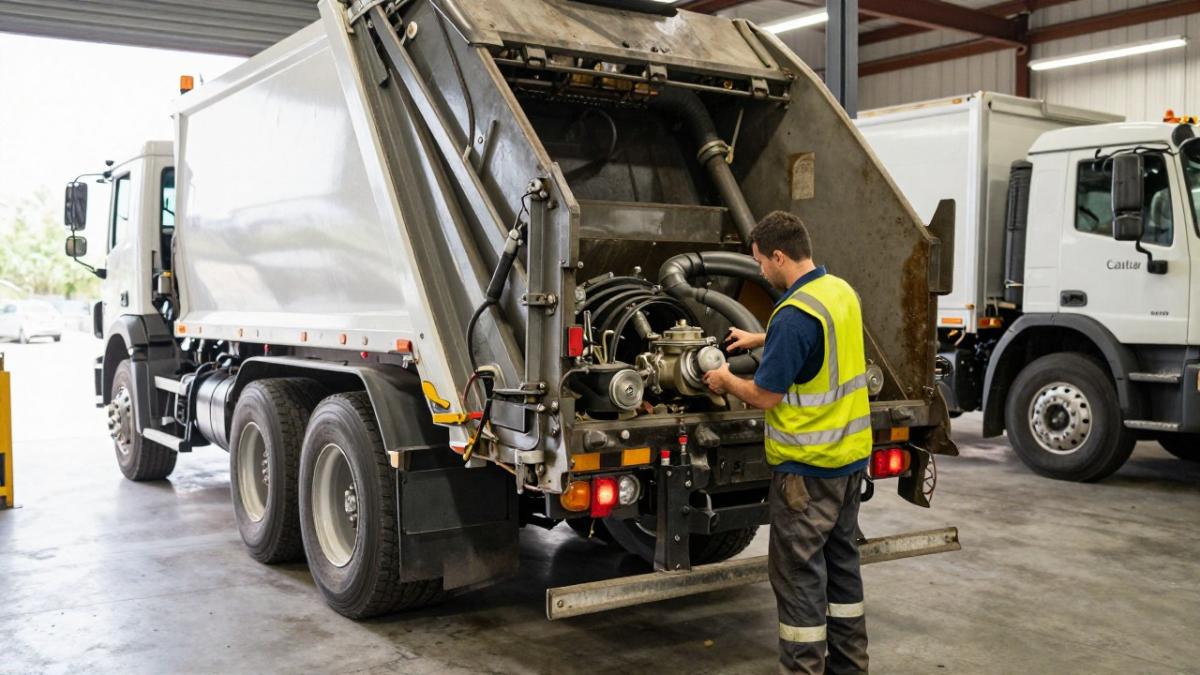
- Brake inspection: A-asset rear loaders get a full brake check on a set mileage interval, with findings logged against the unit.
- Hydraulic servicing: Packer and lift hydraulics get fluid and filter service on hours, not guesswork.
- Tire rotation and pressure checks: daily walkaround plus scheduled rotation to even out wear.
For sanitation-truck-specific strategies that go deeper, read our guide to preventive maintenance strategies for sanitation trucks.
6. The Preventive Maintenance Checklist Your Shop Actually Uses
A preventive maintenance checklist is a one-page, unit-specific task list a tech can complete and sign without guessing. It is the element that turns a plan into a repeatable action.
Build it like this:
- One checklist per asset type, not one for the whole fleet
- Tasks grouped by system: brakes, hydraulics, electrical, tires
- Each task has a pass/fail or measured value field
Keep it to what the tech can finish in the allotted bay time. A checklist so long it gets skipped is worse than a short one that gets used.
7. Preventive Maintenance Best Practices and How to Measure Them
Best practices only count if you can measure them.
The Five KPIs That Matter
Track a small set and review them monthly with the shop and management in the same room.
- PM compliance rate, the share of scheduled preventive work orders completed within their window, divided by the total scheduled in that period. It answers one question: did we do the work we said we would do, on time? A falling rate usually traces to capacity, parts availability, or a schedule that overbooks the shop.
- Planned versus unplanned work, the ratio of planned maintenance labor hours to unplanned repair hours. As a program matures, planned work should grow as a share of total hours. A rising unplanned share means the schedule is not catching failures early enough.
- Backlog age, how long open preventive work orders have been waiting, grouped by age band. Old work orders piling up signal a capacity problem, not a discipline problem, and the fix is usually scheduling or staffing rather than pressure on techs.
How to Interpret the Numbers
A single KPI in isolation tells you little. Read them together:
- High compliance with rising unplanned work means you are doing the scheduled tasks but the tasks are not catching the right failure modes. Revisit intervals and task content.
- Low compliance with low unplanned work can mean the schedule is too light, not that the program is healthy. Check whether tasks are being skipped or whether the schedule under-covers critical assets.
- Rising backlog age with stable compliance usually points to a capacity mismatch, too many scheduled tasks for the available bay hours.
Best Practices That Hold Up
- Tie every KPI to an owner and a review cadence. A number nobody reviews is decoration.
- Use reason codes for missed work. "No parts," "no bay," and "unit on route" are different problems with different fixes.
- Review A-asset performance separately. Fleet-wide averages hide critical-asset problems.
Where Digital Tools Fit
A computerized maintenance management system (CMMS) supports this element by holding asset records, generating work orders from schedules, capturing inspection findings, and producing the reports behind each KPI. The tool does not fix a program on its own.
For concrete benchmarks, see how to track waste fleet maintenance KPIs, and for prevention-focused tactics, our waste fleet breakdown prevention strategies pair well with this section.
Frequently Asked Questions
What are the 7 elements of preventive maintenance?
The seven elements are asset inventory and criticality ranking, inspection and routine checks, testing and servicing, a written preventive maintenance schedule, documented procedures and work orders, technician and operator training, and performance measurement through KPIs. Each element supports the others: an asset registry feeds the schedule, the schedule triggers inspections, and KPIs show whether the program is working. Skip any one and the program tends to drift back into reactive repairs.
How often should fleet preventive maintenance be performed?
Intervals should come from duty cycle, not a generic calendar. Waste trucks run heavy stop-start routes, so many haulers service brakes and hydraulics on hour-meter readings while scheduling oil changes by mileage. Set the first interval from manufacturer guidance, then tighten or stretch it based on inspection findings and failure history. A truck that logs 40,000 miles a year on residential routes needs a different preventive maintenance schedule than one running long-haul transfer work.
What should a preventive maintenance checklist include?
A useful checklist covers the systems that actually fail on your equipment: brakes, tires, lights, fluids, hydraulic lines, packing and seals, and safety equipment. Each line item needs a pass/fail standard and a place for the technician's initials, not just a box to tick. Build separate checklists for daily operator walkarounds and for scheduled shop inspections, and review them quarterly against your repair history so the list keeps matching real failures.
How do you measure the effectiveness of preventive maintenance?
Track PM compliance rate, backlog aging, unplanned downtime, road calls, and cost per mile. A program is working when scheduled work gets done on time and breakdowns fall. Review the numbers monthly with shop leads and management together so both sides see the same picture.