 How-to
Waste Truck Driver Productivity Training: 7-Step Plan
Table of Contents
- Why Driver Productivity Training Matters for Waste Fleets
- The Waste Truck Driver Training Checklist for New Hires
- Waste Fleet Driver Performance Metrics That Drive Results
- Waste Collection Route Optimization Techniques for Drivers
- Waste Collection Driver Coaching: A Step-by-Step Plan
- Balancing Productivity with Safety and Service Quality
- Common Mistakes to Avoid in Driver Productivity Training
- Conclusion
- Frequently Asked Questions
Last Updated: October 20, 2026
Why Driver Productivity Training Matters for Waste Fleets
Waste truck driver productivity training teaches drivers to complete more stops, burn less fuel, and avoid incidents without cutting corners on safety.
The fix is not a lecture. It is a repeatable training and coaching system.
Below is the seven-step plan to lift route completion, cut missed pickups, and keep safety intact.
Most guides treat productivity as a driver attitude problem.
The Waste Truck Driver Training Checklist for New Hires
A new-hire waste truck driver training checklist should cover classroom instruction, hands-on driving practice, and truck familiarization before a driver ever runs a live route alone. Skip a step and you inherit the cost for months.
Here is the checklist we walk fleet managers through:
- Verify commercial driver's license and endorsements before day one
- Complete classroom instruction on company policy and safety rules
- Review collection route maps and stop sequence logic
- Walk the truck: controls, hopper, lift mechanism, safety interlocks
- Complete pre-trip and post-trip inspection training
- Practice driving in a lot, then on low-traffic roads
- Ride along with a senior driver for a full shift
- Run the route supervised before solo assignment
The Federal Motor Carrier Safety Administration sets the commercial driver's license baseline. Your onboarding builds the waste-specific layer on top.
Classroom and Hands-On Driving Practice
Classroom instruction covers the rules; hands-on driving practice builds the reflex. You need both, close together. Front-loading three days of classroom time and then sending a new hire out cold kills retention, so pair each classroom block with truck time the same week.
Vehicle Operation and Truck Familiarization
Truck familiarization teaches the specific vehicle: lift arms, packer cycle, and blind spots on a residential street. A rear-loader and an automated side-loader demand different habits, and your training should say so.
Waste Fleet Driver Performance Metrics That Drive Results
The core waste fleet driver performance metrics are stops per hour, route completion time, missed pickups, fuel efficiency, vehicle downtime, and incident rate. Track all six and you get a full picture.
The useful part is the framework: how each is calculated, what a fair baseline looks like, and how often to review it. Here is a framework for supervisors.
| Metric | How to Calculate | Fair Baseline | Review Cadence | Watch-Out |
|---|---|---|---|---|
| Stops per hour | Completed stops divided by on-route hours, excluding mandated breaks | The route's own 8-week rolling average, not a fleet-wide number | Weekly | Rises if drivers rush unsafe stops or skip container placement |
| Route completion time | Clock time from first stop to last stop, compared with the planned route time | Planned time plus a tolerance set by route density | Daily, reviewed weekly | Punishes drivers for route design flaws and traffic |
| Missed pickups | Count of stops not serviced, coded by cause (blocked access, contamination, driver error) | Route-specific, based on historical access issues | Daily | Can reflect blocked streets, not driver error |
| Fuel efficiency | Miles per gallon or gallons per stop, normalized for load weight and season | Same-route, same-season comparison | Monthly | Weather and load weight shift the number |
| Vehicle downtime | Hours out of service per truck per month, coded by cause | Fleet maintenance baseline | Monthly | Often a maintenance issue, not a driving one |
| Incident rate | Recordable incidents per 100,000 miles or per 1,000 stops | Fleet safety baseline | Quarterly | Small samples hide trends |
Setting Baselines Before You Coach
A metric without a baseline is an argument waiting to happen. Before coaching on stops per hour, pull at least four weeks of the driver's own history on that route so a single bad day does not become the story. Compare each driver to their own route history first, then to similar routes.
Choosing Two or Three Coaching Metrics
Pick two or three metrics to coach on at a time; all six at once overwhelms drivers and dilutes the message. Pair one pace metric (stops per hour or route completion time) with one safety or service metric (incident rate or missed pickups) so the driver never hears "go faster" without "go clean."
A Simple Weekly Scorecard
A one-page scorecard per driver, reviewed weekly, keeps the framework usable. Include the current value, the 8-week baseline, and a trend arrow for each active coaching metric; leave the rest on a monthly summary. The scorecard is a coaching tool, not a discipline file: its job is to start a ten-minute conversation with evidence.
Waste Collection Route Optimization Techniques for Drivers
Waste collection route optimization works best when drivers own the last mile of it. Planners set the sequence. Drivers spot the friction.
Teach drivers to flag these route-level issues:
- Repeatedly blocked alleys or tight turnarounds
- Stops where the container is consistently misplaced
- Dead-end streets that force a long back-out
- Sections where parked cars slow every pass
- Clusters where a small sequence change saves real time
Small changes compound. A driver who shaves a few minutes off a dense residential section does it again the next day, on the same route, for years.
Route-specific training beats generic advice: a driver who knows the route can tell you which stop always runs long and why.
Waste Collection Driver Coaching: A Step-by-Step Plan
Waste collection driver coaching works when it is scheduled, data-backed, and short. Most training programs describe courses; supervisors need a repeatable loop they can run every two weeks. Here is a plan to consider.
- Pull the data. Review telematics and route reports for the prior two weeks. Look for patterns, not single events.
- Pick one focus. Choose a single behavior, such as idling, stop pacing, or backing technique.
- Meet face to face. Ten minutes, one-on-one, in the truck or the yard.
- Show the numbers. Let the driver see the trend against their own baseline, not just hear it.
- Agree on one change. Make it specific, doable, and tied to a route they actually run.
- Coach on the route. Ride along within the next week and watch the behavior in context.
- Set a check-in. Two weeks out, review the same metric again.
- Log the outcome. Record whether the behavior moved, held, or slipped, and decide the next focus.
Step 1: Assess the Driver Against Their Own Baseline
Assessment starts with the driver's own recent history, not a fleet ranking. Pull four to eight weeks of data on the two or three metrics that matter for that route, then add the observation layer: telematics shows what happened, a ride-along shows why. A driver with high idling may be waiting on a locked gate, not resting in the cab.
Book My Complimentary Discovery Call →
Step 2: Set One Specific Goal
A coaching goal should be one behavior, one number, and one timeframe. "Reduce idle time on the Route 12 commercial loop from the current average to the route baseline within four weeks" is a goal. "Be more efficient" is not. Write the goal down and give the driver a copy; drivers who can restate it in their own words are far more likely to hit it.
Step 3: Coach On-Route, Not Just in the Yard
Classroom coaching fades; on-route coaching shows the driver the exact stop, turn, or container placement where the behavior shows up. Keep the ride-along short and focused on the agreed goal, and resist coaching every issue you see. Watch, ask, confirm: watch the behavior, ask the driver what they noticed, then confirm the one change you agreed on.
Step 4: Verify Improvement and Adjust
At the two-week check-in, compare the same metric to the same baseline. If the behavior moved, say so and lock it in.
Using Telematics and Performance Feedback
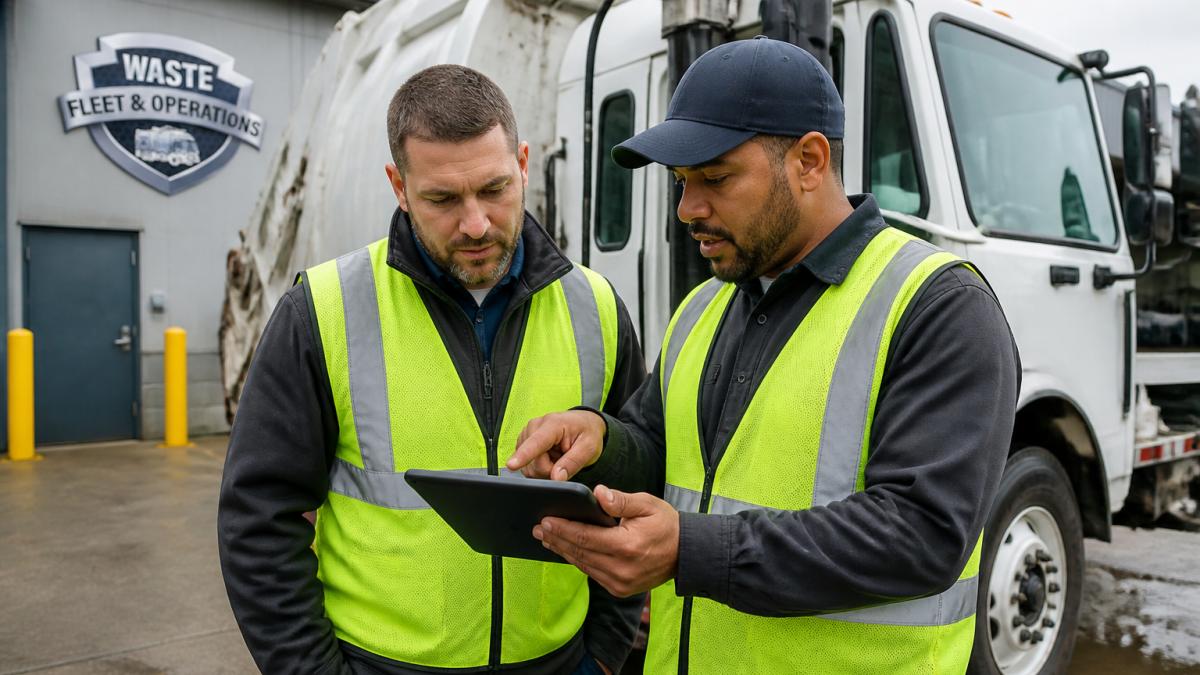
Telematics turns coaching from opinion into evidence. Harsh braking, excessive idling, and speed events give you a starting point drivers cannot argue with. Frame the data as a tool, not a scorecard: drivers respond to "here is what the truck recorded" far better than "here is what you did wrong." Avoid publishing simplistic driver rankings; they invite gaming and damage trust.
Refresher Training and Individual Skill Gaps
Refresher training should target the individual, not the whole fleet. A driver who struggles with tight residential stops does not need the same session as one with a fuel-efficiency problem. Build short, targeted modules, run them quarterly, and revisit any driver whose metrics drift. New hires need route-specific repetition; experienced drivers often need one skill module plus a ride-along to break an old habit.
Balancing Productivity with Safety and Service Quality
Productivity and safety are not a trade-off. Haulers who push pace hardest without training pay for it in incidents and breakdowns. The balance comes from three habits:
- Coach pace and safety together, never pace alone
- Reward clean inspections as much as fast routes
- Treat missed pickups as a service signal, not just a driver fault
Haulers can cut daily breakdowns by 25% to 50% after tightening training and inspection discipline. The productivity gain often follows the safety gain, not the other way around.
Service quality belongs in the same conversation. A route that finishes fast but leaves containers scattered is not productive. It is a callback waiting to happen.
Common Mistakes to Avoid in Driver Productivity Training
The biggest mistake in waste truck driver productivity training is treating it as a one-time event. Training that ends on day thirty fades by day ninety.
Other mistakes we see often:
- Coaching on too many metrics at once. Drivers tune out.
- Blaming drivers for route design flaws. Fix the route first.
- Skipping hands-on truck time. Classroom-only training does not stick.
- Ignoring telematics data. You coach on gut feel and miss the real pattern.
- No refresher plan. Skill gaps reopen quietly.
- No link between shop and management. Drivers hear conflicting messages.
That last one matters more than most fleets realize.
If you want outside help building this, the Occupational Safety and Health Administration publishes guidance on workplace safety programs that pairs well with a driver training plan.
Conclusion
Building a driver productivity training program that sticks takes structure, data, and follow-through.
That is exactly what we do at Waste Fleet & Operations. Our training is built around your operation, not a template, and includes hands-on work with your trucks, root cause analysis, and ongoing progress measurement.
Ready to see what your fleet could look like with a real training system in place?
Frequently Asked Questions
What training does a waste truck driver need?
A waste truck driver needs a commercial driver's license (CDL) plus hands-on training in vehicle operation, truck familiarization, and safety procedures for refuse collection. New hires should complete classroom instruction on operating procedures, defensive driving, and hazard awareness before driving practice on a collection route. A structured waste truck driver training checklist helps ensure no step is skipped, and refresher training keeps skills sharp as routes and equipment change.
How can waste truck drivers improve productivity?
Drivers improve productivity by mastering route-specific efficiency techniques, such as sequencing stops to reduce backtracking and using telematics feedback to smooth acceleration and braking. Coaching on stops per hour, missed pickups, and fuel efficiency gives drivers clear targets. Pairing waste collection route optimization with regular driver coaching helps teams complete routes faster without sacrificing safety or service quality.
How do you measure waste truck driver productivity?
Measure waste fleet driver performance metrics like stops per hour, route completion time, missed pickups, fuel efficiency, vehicle downtime, and incident rate. Track these over time and compare drivers against route baselines rather than each other, since routes vary in density and distance. Telematics systems can supply much of this data automatically, making it easier to spot trends and target coaching where it matters most.
How often should waste truck drivers receive refresher training?
Refresher training should happen at least annually, and sooner after incidents, route changes, or new equipment. Short monthly coaching sessions focused on individual skill gaps work better than one long yearly course. Use performance metrics to decide who needs extra attention, then deliver targeted practice on defensive driving, safe driving, and operating procedures. This keeps waste truck driver productivity training continuous rather than a one-time event.